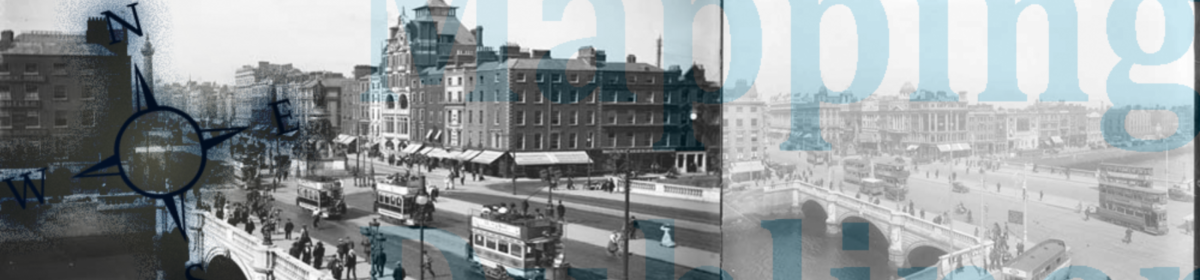
Westmoreland Street

Westmoreland St., Dublin City, Co. Dublin, photographed by Robert French. From the National Library of Ireland's Lawrence Photograph Collection. The view represents a southward look down Westmoreland Street from O'Connell (Carlisle) Bridge. To the left, stretching southeast, is D'Olier Street. Between the two streets is the "central plot directly opposite the bridge" that Christine Casey describes as "the single most conspicuous site in the city" (Casey 422).
Westmoreland St., Dublin City, Co. Dublin, photographed by Robert French between 1865 and 1914. From the National Library of Ireland’s Lawrence Photograph Collection. The view represents a southward look down Westmoreland Street from O’Connell (Carlisle) Bridge. To the left, stretching southeast, is D’Olier Street. Between the two streets is the “central plot directly opposite the bridge” that Christine Casey describes as “the single most conspicuous site in the city” (Casey 422).

Mentioned in three of the Dubliners stories, Westmoreland Street is located in Dublin city center. It runs  from O’Connell Bridge in the north  to its intersection with Grafton and Dame Streets and Trinity College gates in the south. It was built as part of the Wide Streets Commissioners’ “bold geometric plan” to “link … the new N[orth]-S[outh] artery of Upper Sackville Street [now O’Connell Street] and Carlisle Bridge [now O’Connell Bridge] to the Portico of the House of Lords and the N[orth] pavilion of Trinity College entrance front” (Casey 420). As Christine Casey describes in her book Dublin: The City within the Grand and Royal Canals and the Circular Road with the Phoenix Park,

“[The plan] resulted from an extraordinary sequence of events in 1781-2, which included the foundation of the new Custom House, the securing of funds for the long-awaited eastern bridge and the commissioning of the Lords’ extension from James Gandon. Three years laters the commissioners instructed Thomas Sherrard to consult James Wyatt on the ‘distribution of ground for building from Sackville Street to the College.’ No designs by Wyatt are recorded, but in the following year Gandon prepared unexecuted designs for Sackville Street that proposed a unified elevation with ground-floor shops. Carlisle Bridge was opened to pedestrians in 1792 and in the following year Sherrard was instructed to prepare plans for Westmoreland Street. These too were unexecuted, due to the outbreak of war with France. The situation was resolved in 1799 when the proceeds of a clubhouse tax were allocated to the Commissioners. In that year designs by Henry Aaron Baker were approved and demolition began in the area, described as ‘thickly sown with alleys and courts’. Baker initially proposed a street 60 ft (18.2 metres) wide flanked by terraces with Doric colonnades and arched shop-windows. In the eent the colonnades were omitted and the street gained 30 ft (9.1 metres) in breadth. Building began in 1799 and was complete by 1805” (420).

Casey notes that “[c]ontemporaries complained of the streets’ ‘width…bleakness…gloomy and monstrous aspect’ as compared with traditional shopping thoroughfares such as Grafton Street,” but that “these unified street facades have met with universal acclaim from historians for their functionalism and restraint, which finds parallels in contemporary Parisian commercial design and in the domestic terraces of Adam and Dance” (421). Casey’s description continues with detailed historical architectural information on each structure lining the street.

Westmoreland Street is one of many Dublin Streets named after Lords Lieutenant. The 1892 Dublin Street Names, Dated and Explained lists the street as being named in 1801 after John Fane, 10th Earl of Westmorland and Lord Lieutenant of Ireland from 1790 to 1794 (M’Cauley 141).

The first appearance of Westmoreland Street is in “Two Gallants.” Although the two young men would have walked along the street as part of their route from the north side of the city to the south, and Lenehan would have returned to retrace his steps northward along the same path, the only direct reference to the street is made by an unnamed minor character later in the story. As Lenehan stops to talk with some friends he oncounters at the corner of Dame and George’s Streets, one of them mentions Westmoreland Street, where Lenahan would have been only an hour or two previously:

“One said that he had seen Mac an hour before in Westmoreland Street. At this Lenehan said that he had been with Mac the night before in Egan’s. The young man who had seen Mac in Westmoreland Street asked was it true that Mac had won a bit over a billiard match. Lenehan did not know: he said that Holohan had stood them drinks in Egan’s” (D 58).

The party essentially discusses their friend Mac and his presence at two places: last night he was in Egan’s, a pub off of Sackville (now O’Connell) Street just north of the Liffey, and an hour ago he was in Westmoreland Street, which is what O’Connell Street becomes south of the Liffey. Both O’Connell and Westmoreland Street are part of Lenehan’s route though neither are actually mentioned in that context in the story.

[Cabby walking and smoking pipe outside Nos. 32-33 Westmoreland Street], photographed by J.J. Clarke between 1897 and 1904(?). From the National Library of Ireland's Clarke Photographic Collection.
[Cabby walking and smoking pipe outside Nos. 32-33 Westmoreland Street], photographed by J.J. Clarke between 1897 and 1904(?). From the National Library of Ireland’s Clarke Photographic Collection.
The street appears again in “Counterparts,” as it serves as a convenient path for Farrington’s pub crawl. Travelling from Temple Bar to Davy Byrne’s, he must take Westmoreland Street, which is the eastern border of the Temple Bar area, to Grafton Street. As he walks, we are given a description of the bustle along the route:

“In Westmoreland Street the footpaths were crowded with young men and women returning from business and ragged urchins ran here and there yelling out the names of the evening editions. The man passed through the crowd, looking on the spectacle generally with proud satisfaction and staring masterfully at the office-girls. His head was full of the noises of tram-gongs and swishing trolleys and his nose already sniffed the curling fumes of punch” (93).

At this time of day, as Farrington is leaving work, the street, which connects Temple Bar with Dame Street and Grafton Street and O’Connell Bridge, would indeed be filled with Dubliners moving between business, commercial, and residential areas of the city.

Westmoreland Street, Dublin, photographed by Robert French between 1880 and 1900. From the National Library of Ireland's Lawrence Photograph Collection.
Westmoreland Street, Dublin, photographed by Robert French between 1880 and 1900. From the National Library of Ireland’s Lawrence Photograph Collection.

The final reference to Westmoreland Street appears in “Grace,” a story that clearly contains movement from one the pub to the residence of Tom Kernan, although the route is vague and only indirectly marked by geographical indicators. As the cab carrying a drunk and bloodied Kernan moves away from the bar, it “dr[ives] off towards Westmoreland Street” (153). The bar is located somewhere off of Grafton Street and may very well be Davy Byrne’s, where Farrington has been drinking in “Counterparts.” In any case, Kernan’s northward movement along Westmoreland Street is a reversal of Farrington’s southward path as he is only just beginning his revels.

In general, Westmoreland Street serves as a link from north to south in Dubliners. It’s a bustling yet primarily utilitarian link between settings, a place to see and be seen, alive with motion and the movement of characters.

Screenshot from the map showing Westmoreland Street running north and south from the Liffey to the southern edge of Trinity College.

Hungary

Referenced in “After the Race,” Hungary, in central Europe, is the home of Villona, one of Jimmy Doyle’s companions in revelry in “After the Race.”  The reference first appears in the opening paragraph as the race cars come “scudding in towards Dublin” and we are introduced to the four main members of the party:

“In one of these trimly built cars was a party of four young men whose spirits seemed to be at present well above the level of successful Gallicism: in fact, these four young men were almost hilarious. They were Charles Segouin, the owner of the car; Andre Riviere, a young electrician of Canadian birth; a huge Hungarian named Villona and a neatly groomed young man named Doyle” (42-43).

Villona’s place of origin is used several times in the story in place of his name:

“The car ran on merrily with its cargo of hilarious youth. The two cousins sat on the front seat; Jimmy and his Hungarian friend sat behind” (44).

“His father, therefore, was unusually friendly with Villona and his manner expressed a real respect for foreign accomplishments; but this subtlety of his host was probably lost upon the Hungarian, who was beginning to have a sharp desire for his dinner” (45-46).

“The resonant voice of the Hungarian was about to prevail in ridicule of the spurious lutes of the romantic painters when Segouin shepherded his party into politics” (46).

“The cabin door opened and he saw the Hungarian standing in a shaft of grey light:
–Daybreak, gentlemen!” (48).

There are several countries represented in the story, and the group, which expands to six by the end, toasts each of their homes:

“They drank Ireland, England, France, Hungary, the United States of America” (47).

Villona is described as “an optimist by nature,”  “a brilliant pianist,” (43), and a surprise lover of madrigals who “deplor[es] the loss of old instruments” and the “spurious lutes of the romantic painters” (46). He provides the music for the party on various occasions, first humming in the car as they approach the city center and then playing a waltz, a square dance, and voluntaries on the piano aboard the American Farley’s yacht. Despite all his exuberance, though, he is also “unfortunately, very poor” (43).

Location of Hungary in Europe. "EU-Hungary" by NuclearVacuum - File:Location European nation states.svg. Licensed under CC BY-SA 3.0 via Wikimedia Commons - https://commons.wikimedia.org/wiki/File:EU-Hungary.svg#/media/File:EU-Hungary.svg
Location of Hungary in Europe. “EU-Hungary” by NuclearVacuum – File:Location European nation states.svg. Licensed under CC BY-SA 3.0 via Wikimedia Commons – https://commons.wikimedia.org/wiki/File:EU-Hungary.svg#/media/File:EU-Hungary.svg

“After the Race” features primary themes of economic and technological power. Dublin wears “the mask of a capital” (46) as “the Continent sped its wealth and industry” (42) into the paralyzed British dominion. The French Segouin and Reviere indeed represent the glamor of the continent, and the Irish spectators cheer the blue cars even though they had come in second and third in the race. The fist place car is problematized by the fact that it represents Germany but is driven by a Belgian. Nevertheless, the wealth of all those countries in contrast with the “gratefully oppressed” Irish is clear. The Englishman Routh, whom the party of four meets later in the evening is also affluent. To make it worse, he ends the night by winning all of the Irish and American money in cards. Before the IOUs, the Irish Jimmy Doyle is described as having “a great sum under his control” yet acknowledges it isn’t much compared to Segouin and Reviere’s wealth.

Even though technically, he is from the Continent of wealth and industry, the Hungarian Villona is, in fact, the only character described specifically as “very poor.” Rather than stay in the hotel with the Frenchmen, he lodges with Jimmy’s family. He also sits out of the card game apparently because of his lack of bargaining power. The “huge Hungarian” is both appeased and concerned with food as evidenced by his initial “good humour” resulting from “a very satisfactory luncheon” and his obliviousness to Doyle’s father’s subtle boasts due to his “beginning to have a sharp desire for his dinner.” All of this begs the question whether the significance of the reference to Hungary, which is part of the wealth and industry of the Continent, is geographic or linguistic. Villona’s geographic origin seems less a defining factor than his hunger.

Beyond the linguistic play, though, there is something biographical and political about Joyce’s identification of Villona as Hungarian. Villona represents to an extent Oliver St. John Gogarty, Joyce’s friend with whom he had fallen out as he wrote this story. Joyce presents a fuller portrait of his ‘frenemy’ in Ulysses, but as of 1904, Villona, the noisy, hungry, musically inclined, joyful-tempered Hungarian, is mostly harmless. His greatest offense is perhaps leaving Jimmy for the upper deck of the yacht while Jimmy loses at cards.  But although the nuances of personality Joyce may have been embedding in Villona were not yet near those of Buck Mulligan, his character as a symbol is certainly nuanced in its political implications. Coilin Owens unpacks these highly political threads that comprise the relatively short short story in his book Before Daybreak, in which he argues, among other things, that Villona serves to construct a suggestion of devolution:

“When Joyce came to write his story … Griffith’s Resurrection of Hungary, a historical dilation of his political strategy to subvert British authority in Ireland, had appeared and was widely discussed in political circles. Based on the model for Hungarian devolution developed by Ferenc Deák, it proposed the disengagement of Irish Members of Parliament from Westminster and the establishment of a dual monarchy like that of the Austro-Hungarian alliance. Through the figure of the Hungarian Villona, Joyce clearly summons an allegorical reference to this devolutionary strategy” (8).

By making a Hungarian of Villona, whom Owens explains is normally presumed to be “nominally drawn after the French medieval poet François Villon,” Joyce indeed embeds a deeper multivalence to the symbolic qualities of the character.

It is additionally perhaps worth extremely minor note that the first king of Hungary was named Stephen. (Too irresistible to omit.)

Nelson’s Pillar

Erected in 1809 to commemorate Vice Admiral Horatio Lord Nelson, and destroyed 157 years later, Nelson’s Pillar was located, in Joyce’s day, right in the middle of Sackville Street (now O’Connell Street). It stood in the center of the intersection of that main thoroughfare and Henry and Earl Streets. “The Pillar,” as it was also called, appears in Dubliners as a point of reference for the middle of Maria’s route in “Clay:”

“From Ballsbridge to the Pillar, twenty minutes; from the Pillar to Drumcondra, twenty minutes; and twenty minutes to buy the things” (100).

Sackville Street, Dublin, showing the Gresham Hotel and Nelson's Pillar, photographed by Robert French between 1903 and 1908. From the Lawrence photograph Collection at the national Library of Ireland.
Sackville Street, Dublin, showing the Gresham Hotel and Nelson’s Pillar, photographed by Robert French between 1903 and 1908. From the Lawrence photograph Collection at the national Library of Ireland.

The Pillar is a convenient midpoint to her journey, not only because it is located near the cake shop she plans to visit but also because it is a point of intersection for several tram routes, as evidenced in the high traffic depicted in the photo above and in Ulyssese’s “Aeolus” episode where a “hoarse Dublin United Tramway Company’s timekeeper bawl[s]” off tramline destinations (U 7.4-5). The first tram Maria takes, from the southeastern Ballsbridge neighborhood to Dublin city center, lets her off right at the Pillar:

“She got out of her tram at the Pillar and ferreted her way quickly among the crowds” (102).

She first goes east into Earl Street, where Downes’s is located then crosses back west past the pillar (though it isn’t mentioned explicitly) into Henry Street where she buys the plumcake. She returns back to the Pillar (again, not mentioned) to board the Drumcondra tram, where she meets a “colonel-looking gentleman” who offers her his seat. And watching over all of the movement is the Vice Admiral Nelson on his pillar. Perhaps the drunk yet chivalric gentleman in the tram is meant as a kind of lower-ranking Army-branch counterpart to the problematically glorified Royal Navy officer.

Nelson's Pillar, with a tram, O'Connell Street, Dublin City, Co. Dublin, published between 1900 and 1939. From the Eason Collection at the National Library of Ireland.
Nelson’s Pillar, with a tram, O’Connell Street, Dublin City, Co. Dublin, published between 1900 and 1939. From the Eason Collection at the National Library of Ireland.

The memorial to Nelson was one of many that went up around Britain after his death during the Battle of Trafalgar, regarded as “Britain’s greatest naval victory” and the “most decisive naval victory of the [Napoleonic] war.” And while leading up to its unveiling, the Dublin populous seemed either apathetic or supportive of the gesture, once it took its place in the heart of the city, criticism ranged from snarky to impassioned. Andrew Thacker highlights some of the responses in  his book Moving Through Modernity: Space and Geography in Modernism in which he points to an 1809 attack in Irish Magazine that argues “our independence has been wrested from us, not by the arms of France, but by the gold of England” (qtd in Thacker 122). The controversy raged into the twentieth century, and well after the publication of Dubliners. In 1923 W.B Yeats acknowledged its historic and aesthetic value but also admitted “it is not a beautiful object” (qtd in Thacker 123). Thacker also points out that the monument, situated as it is in the center of the city, “inserts Dublin deep within the colonial space of the British capital, the heart of which is often seen as Trafalgar Square with its Nelson’s Column” (120). He furthermore observes “[t]he metropolitan centre of Ireland is thus, paradoxically, not an Irish centre; or to adopt a phrase from Derrida, the centre is not the centre: the Irish metropolis has its governmental centre in London.”

[View of Nelson's pillar following the bombing], by Independent Newspapers, 1966. From the National Library of Ireland.
[View of Nelson’s pillar following the bombing], by Independent Newspapers, 1966. From the National Library of Ireland.
Indeed, the monument does stand in “Clay” at the intersection of religion and economics, both appendages of Britain’s reach in Ireland. Maria’s route from Ballsbridge to Drumcondra, with its pause in the center “to buy the things” forms the shape of a cross. But unlike the sign of the cross whose motion from top to bottom symbolizes Christ’s descent from heaven to earth, Maria moves upward, northward toward Joe’s house, ascending to either her inevitable death as pronounced by the clay she touches or her inevitable entering of the convent as indicated by the prayer-book she chooses on the do-over. Whatever her fortune, her ascension is bisected by her economy. As a person who appreciates “how much better it was to be independent and have your own money in your pocket,” she makes wise purchases (102). Instead of wasting money on one of Downes’s scantily frosted plumcakes, she crosses past the Pillar to buy a cake with more icing on it. But her cross made over the Pillar ends badly when she leaves her prize plumcake in the tram. The whole movement, a sign of the cross over the monument, seems an ironic and ambulatory version of a people’s misplaced reverence for a British Vice Admiral whose victory partially and indirectly won Ireland at least another century of dependence on Britain.

Joyce didn’t live to see the eventual destruction of the monument, which happened in 1966. Just before the 50-year anniversary of the 1916 Easter Rising, a Republican group blew up the pillar, destroying the statue of Nelson at the top and leaving the doric column essentially decapitated. As a result of the attack, the remainder of the monument was removed. That year, “[t]he St Patrick’s day parade and the Easter Rising jubilee celebrations,” according to one historical account, “took place with no Horatio Lord Nelson, Duke of Bronti, viewing them with a jaundiced eye from his column aloft.” And Thacker notes the headline in the March 8, 1966 Irish Times read “NELSON DEFEATED IN THE LONG RUN. ABUSED FOR 157 YEARS” (qtd. in Thacker 122). Today, the Spire, a comparatively apolitical and abstract sculpture, stands where the Pillar once was.

Isle of Man

Map showing the location of the Isle of Man. "British Isles Isle of Man" by Cnbrb - Own work. Licensed under Public Domain via Wikimedia Commons - https://commons.wikimedia.org/wiki/File:British_Isles_Isle_of_Man.svg#/media/File:British_Isles_Isle_of_Man.svg
Map showing the location of the Isle of Man.
“British Isles Isle of Man” by Cnbrb – Own work. Licensed under Public Domain via Wikimedia Commons.

The Isle of Man is an island located in the Irish Sea between Ireland on the west and England and Scotland on the east. Like Ireland, it has Celtic and Gaelic origins and its government was influenced by Viking conquests. The Isle of Man boasts the “oldest continuous parliament in the world.” One of the Tynwald’s houses is called the House of Keys, which is the source of a play on words for Bloom in Ulysses.  It also appears in two stories in Dubliners: “The Boarding House” and “A Little Cloud.”

The first mention of the Isle, in “The Boarding House,” is in relation to the origin of some of the types of tourists that tend to stay at Mrs. Mooney’s establishment:

“Mrs. Mooney, who had taken what remained of her money out of the butcher business and set up a boarding house in Hardwicke Street, was a big imposing woman. Her house had a floating population made up of tourists from Liverpool and the Isle of Man and, occasionally, artistes from the music halls” (62).

Don Gifford suggests in his annotations that the reference implies the boarding house guests are from an “extraordinarily rowdy citizenry” (Gifford 63). Given the location of the boarding house in Hardwicke Street and description of Mrs. Mooney’s necessary demeanor with her residents (“She governed her house cunningly and firmly, knew when to give credit, when to be stern and when to let things pass. All the resident young men spoke of her as The Madam.”), Gifford’s suggestion is probably correct. In this story, then, the Isle of Man implies a certain raucousness that could be a danger to someone less worldly-wise than any member of the Mooney clan.

Little Chandler, on the other hand, is indeed less worldly-wise. In “A Little Cloud,” he is scoffed at by Gallaher for his travel destinations, which amount to the Isle of Man:

“–Tommy, he said, I see you haven’t changed an atom. You’re the very same serious person that used to lecture me on Sunday mornings when I had a sore head and a fur on my tongue. You’d want to knock about a bit in the world. Have you never been anywhere even for a trip?

–I’ve been to the Isle of Man, said Little Chandler.

Ignatius Gallaher laughed.

–The Isle of Man! he said. Go to London or Paris: Paris, for choice. That’d do you good.” (76)

To Gallaher, who has been living in London for the past eight years, the Isle of Man would seem to be pretty bland and uninteresting, and about as unworldly as you can get. Given these two references, it would seem, in fact, that it makes more sense for someone from the Isle of Man to visit Dublin rather than the other way around.

That the reference appears in these two consecutive stories does invite a comparison between its implications in each case. On one hand it’s the origin of rowdiness, something to be cautious of, while on the other, it’s boring and droll, far less interesting perhaps than Dublin itself. That it is so insignificant in “A Little Cloud” suggests that the ruffians that inhabit the boarding house aren’t quite as tough to deal with as the Mrs.-Mooney-esque narrator would have us believe. And at the same time, the roughness of the Manx citizenry in “The Boarding House” might suggest that Gallaher is just as pompous and boastful as he appears to be; he shrugs off the “extraordinarily rowdy citizenry” as tame compared to the company he’s used to keeping in places like London and Paris. Of  Paris, Gallaher exclaims, “Hot stuff! Not for a pious chap like you, Tommy” (76). And when Chandler asks whether the city is immoral, Gallaher suggests going to one of its students’ balls: “That’s lively, if you like, when the cocottes begin to let themselves loose” (77). Based on his description of these cocottes, it may well be that Polly Mooney, quite able to handle the rough men of her mother’s establishment, could manage just fine in a place like Paris or even London, which Gallaher says is just as debauched as Paris. Instead, she’s kept in Dublin, by her mother, to marry Bob Doran, another kind of Chandler or Eveline. They are all trapped in the stasis of Ireland by the economics of familial duty. (Eveline is kept in place by her mother’s memory and her father, whom she supports; and Little Chandler, though he wants to travel like Gallaher or even just write poetry for an English publisher, is kept in place by his child and wife and the furniture he bought “on the hire system” [83].)

Incidentally, the ship Frank boards at the end of “Eveline,” would have most likely sailed first to the Isle of Man before going on to Liverpool where the ship to Buenos Ayres would have sailed from. The familial economics in each of these stories corresponds with the characters’, and Ireland’s, dependence on the British economy. Likewise, the Isle of Man is, although technically self-governing, a British Crown dependency. The Isle of Man, and its status as a Crown dependency, could very well represent the economic paradox that keeps the characters of Dubliners tied to Ireland through their livelihood’s dependence on  a market controlled by England, a country that taunts them with the mirage of opportunity if they could only get there.


Adam and Eve’s

Adam and Eve's (Church of the Immaculate Conception) as seen from the south bank of the Liffey in Merchant's Quay. Photograph by Jasmine Mulliken, May 31, 2015.
Adam and Eve’s (Church of the Immaculate Conception) as seen from the south bank of the Liffey in Merchant’s Quay. Photograph by Jasmine Mulliken, May 31, 2015.

Adam and Eve’s, the Fransiscan church mentioned in “The Dead,” was, from 1889 on, officially the Church of the Immaculate Conception. The nickname, which predates the official name, comes from the nearby Adam and Eve tavern, where mass was held secretly during the time of the penal laws. The church, which has been rebuilt, remodeled, and rearranged several times since the initial friary was built on the site in 1615,  sits on the south bank of the Liffey between Merchant’s Quay and Cook Street and besides its dome, is rather inconspicuous from the Liffey-side entrance. It’s just downhill from the historic and very conspicuous Christ Church, which conformed to Henry VIII’s new religious code during the reformation. Christ Church saw the first performance of Handel’s Messiah in 1742 and remained part of the Church of Ireland after the penal laws were lifted. Though not as renowned, Adam and Eve’s also had a choir, and leading the sopranos was Julia Morkan, Gabriel Conroy’s aunt in “The Dead:” “Julia, though she was quite grey, was still the leading soprano in Adam and Eve’s” (176).

Adam and Eve’s is just down the quays from 15 Usher’s Island, where the aunts live and where the first half of “The Dead” is set. Just after Julia performs “Arrayed for the Bridal” for her guests at their annual party, her sister Kate brings up the subject of the pope’s 1903 Motu Proprio: Inter Sollicitudines, which forbade women singing in choirs:

Aunt Julia shrugged her shoulders and said with meek pride:

“Thirty years ago I hadn’t a bad voice as voices go.”

“I often told Julia,” said Aunt Kate emphatically, “that she was simply thrown away in that choir. But she never would be said by me.”

She turned as if to appeal to the good sense of the others against a refractory child while Aunt Julia gazed in front of her, a vague smile of reminiscence playing on her face.

“No,” continued Aunt Kate, “she wouldn’t be said or led by anyone, slaving there in that choir night and day, night and day. Six o’clock on Christmas morning! And all for what?”

“Well, isn’t it for the honour of God, Aunt Kate?” asked Mary Jane, twisting round on the piano-stool and smiling.

Aunt Kate turned fiercely on her niece and said:

“I know all about the honour of God, Mary Jane, but I think it’s not at all honourable for the pope to turn out the women out of the choirs that have slaved there all their lives and put little whipper-snappers of boys over their heads. I suppose it is for the good of the Church if the pope does it. But it’s not just, Mary Jane, and it’s not right.”

She had worked herself into a passion and would have continued in defence of her sister for it was a sore subject with her but Mary Jane, seeing that all the dancers had come back, intervened pacifically:

“Now, Aunt Kate, you’re giving scandal to Mr. Browne who is of the other persuasion.”

Aunt Kate turned to Mr. Browne, who was grinning at this allusion to his religion, and said hastily:

“O, I don’t question the pope’s being right. I’m only a stupid old woman and I wouldn’t presume to do such a thing. But there’s such a thing as common everyday politeness and gratitude. And if I were in Julia’s place I’d tell that Father Healey straight up to his face…” (194-95)

That Julia is “still the leading soprano in Adam and Eve’s” suggests that Father Healey has yet to enforce the papal rescript, but from Kate’s comment, it seems he’s ultimately headed that direction. The entire rescript, which was a papal decree independent of any input from bishops or cardinals, addressed what Pope Pius X saw as “the abuse affecting sacred chant and music.” He saw this “abuse” as an effect of the “fatal influence exercised on sacred art by profane and theatrical art” and feared and derided “that pleasure that music directly produces, and that is not always easily contained within the right limits.” Thus, to take the sin out of music, and to preserve the “sanctity and dignity of the temple,” he proposed a list of rules regarding the music of the church. One of these twenty-nine decrees banned women from singing in the choir:

13. On the same principle it follows that singers in church have a real liturgical office, and that therefore women, being incapable of exercising such office, cannot be admitted to form part of the choir. Whenever, then, it is desired to employ the acute voices of sopranos and contraltos, these parts must be taken by boys, according to the most ancient usage of the Church.

Interior of Adam and Eve's, facing east toward the altar. The Merchant's Quay entrance is to the left (north) and the Cook Street entrance to the right (south). Photograph by Jasmine Mulliken, May 31, 2015.
Interior of Adam and Eve’s, facing east toward the altar. The Merchant’s Quay entrance is to the left (north) and the Cook Street entrance to the right (south). Photograph by Jasmine Mulliken, May 31, 2015.

Like so many churches, Adam and Eve’s would have had excellent acoustics for a choir of any kind. Its dome was built in or shortly after 1900 at the same time the inside was rearranged and expanded. Today, the church even houses “the largest Catholic church organ in Dublin [which] has been described as one of the finest in the country.”

As a singer himself, any affinity Joyce may have begrudgingly retained for the Catholic Church would have undoubtedly included its music. Joyce celebrated and revered music, and his admiration for women singers is evident in the character of Molly Bloom, also a soprano, who “displayed at an early age remarkable proficiency as a singer having even made her bow to the public when her years numbered barely sweet sixteen” (U 16.1442-44). It’s easy to read Joyce’s own sentiments in Kate’s impassioned protests of the pope’s ban on women singing. Furthermore, Joyce would surely have noted the irony of this particular church, nicknamed after Eve and officially named after Mary, implementing such a restriction on the female voice. And perhaps it’s a counter to the papal res(c/t)ri(p/c)t that just as the church appears again in the story, Gabriel is right in the middle of imagining calling gently to his wife as she’s undressing. Actually, the church is not mentioned at all, but it’s clear from the line that interrupts his thoughts that they are just passing Adam and Eve’s on their walk from the Morkans’ house after the party:

“Like distant music these words that he had written years before were borne towards him from the past. He longed to be alone with her. When the others had gone away, when he and she were in the room in their hotel, then they would be alone together. He would call her softly:

–Gretta!

Perhaps she would not hear at once: she would be undressing. Then something in his voice would strike her. She would turn and look at him….

At the corner of Winetavern Street they met a cab.” (214)

The couple would be walking by the front doors of Adam and Eve’s just before they reached the corner of Winetavern Street. The omission of the geographical reference (further emphasized by the ellipsis) and the replacement of it with Gabriel’s desire for Gretta subverts the power of the church and re-situates that power within the female body. Ultimately, Julia’s voice will resurface in Gabriel’s mind and Gretta’s voice will usurp the story altogether.

The foyer of the church also displays a plaque of important dates in its history, some of which include the publication of Joyce’s works.

A list of  "Important Dates" posted in the foyer of Adam and Eve's.
A list of “Some Interesting Dates” posted in the foyer of Adam and Eve’s. Photograph by Jasmine Mulliken, May 31, 2015.

Antient Concert Rooms

The Antient Concert Rooms, located at 52 Great Brunswick Street (now Pearse Street) from 1842 to 1921, is the primary setting in “A Mother” and is mentioned again briefly in “The Dead.”

Antient Concert Rooms building. From archiseek.

In “A Mother,” Mrs. Kearney is unsurprised when her daughter’s skills as an accompanist are solicited by Mr. Holohan for “a series of four grand concerts which his Society was going to give in the Antient Concert Rooms” (138). This type of series would have been a typical event at the Concert Rooms, and Joyce himself even performed there in a similar program. The Concert Rooms are also used by Mary Jane in “The Dead” as the venue for her annual pupils’ concert: “She had been through the Academy and gave a pupils’ concert every year in the upper room of the Antient Concert Rooms” (176).

Antient Concert Rooms perhaps in its previous iteration as Dublin Oil Gas Light Company. From archiseek.

Before the Antient Concerts Society inhabited the premises, it was the home of the Dublin Oil Gas Light Company. Although the premises at 52 Great Brunswick Street was acquired by the Society (for which the venue is named) in 1842, the first performance at the location was not until 20 April, 1843. In his historical account of the society and its role in establishing the venue, Patrick J. Stephenson cites a notice and report of the events:

“‘ANTIENT CONCERTS. OPENING of THEIR NEW Rooms, GREAT BRUNSWICK STREET. The Committee request that all parties attending the Oratorio This Evening, will proceed by Brunswick-street, in order that the Carriages may set down with the horses’ heads towards Westland-row.’

A big attendance was expected and, judging by the Press reports, the committee were not disappointed. The report of the concert published by the Dublin Evening Mail reads as follows:

‘The members of this select and spirited society opened their new rooms in Great Brunswick-street, yesterday evening [2o April] to a large number of their friends, in a style creditable alike to themselves and to Dublin. The building is still in an unfinished state, owing to the short time that has elapsed since the works were commenced ; but when completed, will not be inferior, for the purposes for which it was constructed, to any other in Europe.

The principal room (in which the concert was given is in the Ionic style, and beautifully proportioned, being nearly a double cube of 43 feet, or 86 feet long, exclusive of the recess for the organ at the back of the orchestra, and it is calculated to accommodate between goo and i000 persons. At the extremity of the hall, and facing the orchestra, supported on metal pillars, is a light looking elliptical gallery, capable of holding two hundred persons. The massive scroll brackets, supporting the gas pendants, from the foundry of Mr. William Robinson, are particularly elegant, and the. remainder of the fittings for the lighting, by Milner and Co., of Fleet-street, are equally so. The room, besides being lofty, is well ventilated by admitting warmed or cold air diffusedly round the bottom of the room, and carrying off the foul air through ornamental openings in the ceiling, and thence, by inverted funnels in the roof, out of the building.

The The seats are supported on light-looking cast iron framing with scroll arms, and backed with mahogany, affording altogether a degree of comfort that was not known in any music-room in Dublin before. We may fairly say that when the seats are cushioned, a new organ put up, and the painting and decorations completed, it will display an appearance presenting architectural beauty, combined with comfort, such as no other hall in this country possesses, and will reflect the highest credit on the committee of the society by whom the work has been designed, and under whose inspection it has been executed.” (qtd. in Stephenson 6-7)

Stephenson provides the entire report, which continues with an account of the performances and attendees and ends with the summation, “A good concert room” (8). Throughout the years, many different musical societies utilized the Antient Concert Rooms, and the initial format for concerts, which had been “first, a short or shortened major work, such as Haydn’s ‘Seasons’, Mozart’s ‘Requiem’, Spohr’s ‘Cruci fixion’ or Handel’s ‘L’Allegro’; second, a series of songs, glees, madrigals, duets, and quartettes,” gave way to any number of program arrangements (8). The subject of concerts also changed. Originally, “[t]he first part had, as a rule, a marked sacred or religious character, and the second a profaner or lighter tone” (8). By Joyce’s time, the Rooms were not only a place to hear concerts but also the venue for events like “the spectacular Dawson-Stevenson billiards match” which took place in May and June of 1904, just a couple months before James Joyce sang there as part of the six-day Irish Revivals Industries Show (Simpson). He performed solo on the 24th and “alongside the celebrated John McCormack in the Grand Irish Concert on the Saturday evening (27 August),” as John Simpson notes in his thorough annotation of the Antient Concert Rooms as referenced in Ulysses. Incidentally, when the place is referenced in Ulysses, it’s as Bloom is on his way to Paddy Dignam’s funeral. As he looks out the window of the cab, he notes “Antient concert rooms. Nothing on there” (U 6.180).

Eustace Street

Eustace Street, Dublin City, Co. Dublin, photographed by Robert French between 1865-1914. Part of the Lawrence Photograph Collection, National Library of Ireland.

Eustace Street, which appears only in “Counterparts,” is the street where Farrington’s office is located. He is a copyist, or a scrivener, like the famous Bartleby, who, like Bartleby, has had enough of taking orders from his boss. But unlike Melville’s scrivener who simply responds to any request with “I would prefer not to,” Farrington acts out quite emotionally throughout the story in response to slight after slight. The first of these slights come from his boss, Mr. Alleyne of Crosbie & Alleyne, solicitors. (Thom’s 1904 directory lists a C.W. Alleyne at the corner of Eustace and Dame Street, though as Gifford notes, there is no Crosbie listed on the premises [Gifford 74]). Alleyne calls Farrington into the office where he reprimands him for not finishing a copy on time, giving excuses for “shirking work,” and taking too long on his lunch breaks (87).

Alleyne tells Farrington to finish the copies immediately, to which he responds “Yes, sir.” But after writing out a few words, Farrington decides to get a porter to get his motivation up. He heads to O’Neill’s shop and by the time he returns to the office,

“Darkness, accompanied by a thick fog, was gaining upon the dusk of February and the lamps in Eustace Street had been lit” (89).

Eustace connects Dame Street on the south, a busy thoroughfare containing shops, banks, and other financial establishments, with Temple Bar on the north, an area that includes places like Terry Kelly’s pawn office in Fleet Street and the employer of Jack Mooney in “The Boarding House,” who is “a hard case,” and as Gifford suggests, could be involved in the “debt-collection side of a commission agency” (Gifford 63). In other words, Eustace Street connects ideas of institutionalized money with perhaps ‘hard-got’ money.

Screenshot from the Google map showing Eustace Street and the beginning of Farrington's route.
Screenshot from the Google map showing Eustace Street and the beginning of Farrington’s route.

Eustace Street itself has an eclectic history. One report, which chronicles the history of 17 Eustace Street, explains, “Eustace Street can be considered quite unique as throughout its history it accommodated such a broad range of occupants from a Lord Mayor of Dublin, Sir Thomas Blackhall, through to merchants, goldsmiths, gunmakers and solicitors” (Somerville-Woodward & Morris 3).

One particular implication of the reference to the street, though, is political. According to one of several historical accounts of the Temple Bar area, although “Eustace Street was named after Sir Maurice Eustace, Speaker of the House of Commons and Lord Chancellor, who died in 1665 and whose house and gardens stood on the site of this street,” it was also where the Eagle Tavern was located. This tavern was the setting for “[t]he inaugural meeting on 9 November 1791 of the Dublin Society of United Irishmen … with Simon Butler as chairman and Napper Tandy as secretary.” The United Irishmen, led by Wolfe Tone was prominent in the 1798 rebellion that sought to end British rule in Ireland.

It’s possible that the street, with its republican connotations is, as a passageway, itself a kind of rebellion by Farrington against Mr. Alleyne. The narrator refers twice to Alleyne’s North of Ireland accent, which may indicate he has unionist leanings. The description appears, in fact, in the opening lines of the story as Alleyne is “furiously” calling for the scrivener:

“The bell rang furiously and, when Miss Parker went to the tube, a furious voice called out in a piercing North of Ireland accent:

–Send Farrington here!” (86)

The description appears again in the context of Farrington mocking Alleyne, which he does throughout the night to his friends:

“But they had never pulled together from the first, he and Mr. Alleyne, ever since the day Mr. Alleyne had overheard him mimicking his North of Ireland accent to amuse Higgins and Miss Parker: that had been the beginning of it” (92).

Much of the tension and frustration Farrington experiences seem to be a kind of embodiment of the frustration Ireland as a whole felt under the dictates of British rule. And indeed, later in the night, a London woman slights Farrington, another enactment of the British-Irish dichotomy symbolically fueling Farrington’s rage.

The hidden political connotations implied by the reference to Eustace Street only add depth to the story’s complex commentary of the frustrated Irish worker in a British economy.

Winetavern Street

Located in the ancient Dublin city center, Winetavern Street, though only briefly mentioned, plays an interesting role in Dubliners. In “The Dead,” the collection’s final story, Gabriel and Gretta are finally able to find a cab after the party where Winetavern Street meets the quays on the south bank of the Liffey where they have been walking: “At the corner of Winetavern Street they met a cab” (214). They had been unable to get a cab at the aunts’ house in Usher’s Island two quays west of Winetavern Street, which divides Merchant’s and Wood Quays. At the end of the party, the guests can only manage to get one cab, which is claimed by Freddy Malins, his mother, and Mr. Browne, so Gabriel and Gretta, along with Bartell D’Arcy and Miss Callaghan, begin walking east along the quays in hopes they’ll meet a cab closer to the city center.

Winetavern Street, pen, ink, and watercolor by Flora H. Mitchell.

The most obvious reason for the lack of cabs is the time of year and time of day. It’s generally agreed that the Morkans’ party takes place between January 2nd and 6th, between New Year’s and the Feast of Epiphany. Furthermore, when the guests leave, “[t]he piercing morning air” (206) is already making its way into the hall, and yet as the group begins their walk, “[t]he morning was still dark. A dull yellow light brooded over the houses and the river” (212). During the 2nd to the 6th of January, the sun rises at around 8:15 am, and stars start becoming imperceptible at about 6 am. Nevertheless, it is early enough still when they leave for sunrise to be a a long way off as is indicated by the need for a candle when the couple arrives at the hotel. Indeed the street lamps are still lit when Gabriel sits alone at the end of the story imagining his journey westward.

The walk from 15 Usher’s Island to the corner of Winetavern Street, according to the map, would take 8 minutes. Since a horse travels between 4 mph (6.4 kph) at a walk and 8 mph (13 kph) at a slow trot, the cab ride would have taken about another 10-15 minutes. If we imagine the entire scene at the hotel spans an hour, then the time between the end of the party and the end of the story is roughly an hour and a half. Could the party have gone on until 4:30 am? That seems unlikely. Nevertheless, that the morning is spilling into the hall at the start of the journey and the street lamps are still lit at the end of the story indicate that the group had to procure their cabs sometime between midnight and 4:30 am. Surely there would be a lack of cabs during these hours, especially over the holidays.

The photo, "Imperial Hotel and coaches, The Mall, Waterford," shows two horse-drawn cabs. Photo taken between 1900 and 1910, from the National Library of Ireland.
The photo, “Imperial Hotel and coaches, The Mall, Waterford,” shows two horse-drawn cabs. Photo taken between 1900 and 1910, from the National Library of Ireland.

But other tensions surround the procuring of cabs in the story as well. First, cabs are the only mode of transportation used in the stories following “A Painful Case.” There is a distinct lack of movement and mappable travel in the stories between that one and “Grace.” It is as if Emily Sinico’s death by train halts all travel, at least by means of apparatus. We first see a cab appear in “Grace,” as an inebriated and bloodied Mr. Kernan is being loaded into it by Mr. Power. Because Mr. Kernan can’t speak, Mr. Power must give the directions to the driver. Similarly, the first cab, in “The Dead,” the Browne-Malins cab, appears in a fog of confusion. Mr. Browne only reluctabtly gets into the cab, and then he and Mr. Malins give the driver contradictory directions. Ultimately, the driver is asked “Do you know Trinity College?” a rather insulting question for a Dublin cab driver, and told to “drive bang up against Trinity College gates,” instructions that connote a potentially bloody end to this inebriated group’s trip.

But even Gabriel and Gretta’s cab, which seems innocuous enough, is associated with threatening layers. They find the cab at Winetavern Street, a street named historically for its primary premises–taverns. According to J.T. Gilbert’s 1851 A History of the City of Dublin, the street, which was also called Wine-street, was the site of a violent fire. Gilbert cites “the native annalists record” which details the 1597 events:

“One hundred and forty-four barrels of powder were sent by the Queen to the town of the ford of hurdles (Dublin) to her people, in the month of March. When the powder was landed, it was drawn to Wine-street…,  and placed on both sides of the street, and a spark of fire got into the powder; but from whence that spark proceeded, whether from the heavens, or from the earth beneath, is not known; howbeit, the barrels burst into one blazing flame and rapid conflagration (on the 13th of March), which raised into the air, from their solid foundations and supporting posts, the stone mansions and wooden houses of the street, so that the long beam, the enormous stone, and the man in his corporal shape, were sent whirling into the air over the town by the explosion of this powerful powder; and it is impossible to enumerate, reckon, or describe, the number of honourable persons, of tradesmen of every class, of women and maidens, and of the sons of gentlemen, who had come from all parts of Erin to be educated in the city, that were destroyed. The quantity of gold, silver, or worldly property, that was destroyed, was no cause of lamentation, compared to the number of people who were injured and killed by that explosion. It was not Wine-street alone that was destroyed on this occasion, but the next quarter of the town to it.” (qtd. in Gilbert 154-55)

Though increasingly less direct, the connotations of drunkenness and disastrous injury present in the three instances of even primitively mechanized transportation after the disaster in “A Painful Case” show a wariness with the potential speed of movement. And though the cab Gabriel and Gretta find at Winetavern Street and their successful journey seems to indicate a gradual re-implementation of the evolving technology driving transportation at the turn of the century, the underlying historical connotations that are conveyed through the reference to this particular street suggest forward movement may not be re-evolving quite as smoothly as it appears to be.

“The Dead” Route

At the end of “The Dead,” Gabriel concludes that “[t]he time had come for him to set out on his journey westward” (223). Gabriel imagines himself moving from east to west, landing like the snow on various places on the Irish map: “the dark central plains,” “the treeless hills,” “the Bog of Allen,” “the dark mutinous Shannon waves,” and finally “the lonely churchyard on the hill where Michael Furey lay buried” (223-24). The imagined route from Dublin to Oughterard (near Galway), where Michael Furey is most likely buried, is roughly 230 km. It’s a significant journey and conveys Gabriel’s capacity for empathy and his desire to close the distance he feels lies between himself and his wife.

But the imagined route is much different than the actual route the couple travels in the story. Instead of east to west, Gabriel and Gretta make their from the Misses Morkan’s house in Usher’s Island eastward and then a little northward to the Gresham Hotel in Sackville (now O’Connell) Street. Instead of the plains, hills, bog, waves, and churchyard, they see Usher’s Island, the Four Courts, Winetavern Street, O’Connell Bridge, and the Gresham. And instead of flying gently through the air like snow, they walk a bit before upgrading to a cab that makes a “rattling noise” that drowns out any attempt at conversation. Though it’s not referenced in relation to their route,  they would also have passed Adam and Eve’s, where Julia is lead soprano.

The physical eastward movement is in direct contrast to the imagined westward movement of Gabriel’s ‘swooning soul.’ The contrast is yet another indication of the ambivalence that defines Gabriel and his circumstances. He’s drawn westward though he’s more comfortable in the east. At the party he feels himself to be a failure only to be met with applause and laughter when he performs. He envisions his life with Gretta romantically and looks forward to arriving at the hotel where he will seduce her but instead learns she had a lover before him that he can never compare to. The cemetery, the final destination of the imagined journey west, is permanent and powerful, whereas the destination of the physical journey, the hotel, is transitional and temporary.

Nevertheless, it is a journey, and the first distinct route illustrated in the text since “A Painful Case.” The three public life stories preceding “The Dead” make reference to many places but there is a lack of movement, a kind of paralysis initiated perhaps by the tragedy of “A Painful Case.” Mrs. Sinico’s death (she’s hit by a train) puts a halt to transportation and movement for the Dubliners until the end of the final story. In “The Dead,” we see a return to movement and re-evolution of transportation methods. From the immobility of the previous public life stories, the movement of “The Dead” starts slowly, with simple walking. Gabriel and Gretta walk five blocks (650 meters) from Usher’s Island to Winetavern Street and cover the remaining 1.5 km to the Gresham in a rattling cab.

While in one way the physical journey counters the imagined journey, perhaps painting Dublin as a kind of paralytic space working against the transcendent space of the imagination, the presence of a physical journey at all indicates a break from the immobility of the previous stories, a kind of return to the ease of movement that characterizes the childhood stories. And it’s fitting, then, that the final destination of the journey in “The Dead” is just steps away from Great Britain Street, the very first geographical reference in the opening story of Dubliners.

Ormond Quay

Ormond Quay is one of many waterfront spans of street lining the Liffey in central Dublin. Situated on the north bank, its upper (western) and lower (eastern) sections are bisected by Capel Street as it becomes Grattan Bridge. In association with Joyce’s works, it’s perhaps most recognized as the location of the Ormond Hotel, the setting for Ulysses’s Sirens episode where Bloom listens to and ruminates on music after tortuously yet curiously observing Blazes Boylan just before he is to meet Molly.

"[View of the River Liffey and Ormond Quay, Lower, taken from south quays]." Photograph by J.J. Clarke. From the Clarke Photographic Collection at the National Library of Ireland.
“[View of the River Liffey and Ormond Quay, Lower, taken from south quays].” Photograph by J.J. Clarke. From the Clarke Photographic Collection at the National Library of Ireland.
But Ormond Quay is also where Mr. Kearney, of “A Mother,” is a bootmaker:

“However, when she drew near the limit and her friends began to loosen their tongues about her, she silenced them by marrying Mr. Kearney, who was a bootmaker on Ormond Quay” (137).

Don Gifford emphasizes that “[a] bootmaker should not be confused with a cobbler; bootmaking is an honored middle-class profession in England and Ireland” (Gifford 97). Miss Devlin marries Mr. Kearney both to silence her friends and to ensure her future security, “perceiv[ing] that such a man would wear better than a romantic person” (D 137).

Aside from sharing a geographical reference, “A Mother” and Ulysses also share a character: Mr. O”Madden Burke. In “A Mother,” O’Madden Burke is decribed as “a suave, elderly man who balanced his imposing body, when at rest, upon a large silk umbrella. His magniloquent western name was the moral umbrella upon which he balanced the fine problem of his finances. He was widely respected” (145). We learn that Burke is to write the report of the concert and that Mr. Hendrick from the Freeman will “see it in.” Burke also appears in Ulysses, in the Aeolus episode set in the Freeman office, “tall in copious grey of Donegal tweed” as he “c[omes] in from the hallway.” During the spirited conversation among the group (which includes Lenehan who appears both in the novel and “Two Gallants”), the umbrella appears again:

“Lenehan announced gladly:

—The Rose of Castile. See the wheeze? Rows of cast steel. Gee!

He poked Mr O’Madden Burke mildly in the spleen. Mr O’Madden Burke fell back with grace on his umbrella, feigning a gasp.

—Help! he sighed. I feel a strong weakness” (U 7.590-94).

The reference to The Rose of Castile foreshadows the Sirens episode, set in Ormond Quay, where it figures prominently as one of the musical allusions. And just as O’Madden Burke appears first in “A Mother,” so too perhaps does Mr. Kearney the bootmaker of Ormond Quay make a brief appearance, at least as a playful phrase, in Ulysses: 

“(A hackneycar, number three hundred and twentyfour, with a gallantbuttocked mare, driven by James Barton, Harmony Avenue, Donnybrook, trots past. Blazes Boylan and Lenehan sprawl swaying on the sideseats. The Ormond boots crouches behind on the axle. Sadly over the crossblind Lydia Douce and Mina Kennedy gaze.)” (U 15.3726-31).

But what does the reference to Ormond Quay contribute to our reading of “A Mother?” The reference, like so many of Joyce’s geographical references, may recall a time before the story’s setting.  Incidentally, in 1850, there were two bootmakers listed in Thom’s Directory in Ormond Quay: William Muldary at 16 Lower Ormond Quay, and James Henry Baird at 11 Upper Ormond Quay. Furthermore, in “Robert Emmet’s Rising of 1803 and the Bold Mrs. Kearney: James Joyce’s ‘A Mother’ as Historical Analogue,” Martin F. Kearney explores the connections between the concert in “A Mother” and Robert Emmet’s 1803 uprising, pointing out that Anne Devlin is evoked in Mrs. Kearney’s maiden name Devlin, setting the stage for a much more politically charged story than what many of the early critics recognized. The author Kearney traces several interesting and convincing parallels between Anne Devlin and Mrs. Kearney, but he also suggests that Mr. Kearney’s character also carries correlative implications to the 1803 uprising. He notes, for example, that there were two Kearneys involved in the events: William Kearney, who “concealed Emmet and several rebel officers in the garret of his inn” (para. 18); and Edward Kearney, who “was the first to be executed, having been adjudged guilty of participation in the bid for Ireland’s freedom. The religious fervor of Joyce’s Mr. Kearney gains poignancy with the realization that Edward Kearney was forced to face the scaffold without benefit of a priest to hear his last confession or to offer spiritual comfort” (para. 18). Most interestingly, though, William Cole, a shoemaker, followed in the footsteps of William Kearney and hid Philip Long, a major member of the uprising, in his house in Ormond Quay. That Joyce stepped Mr. Kearney up from a shoemaker to a bootmaker may be a nod to Emmett’s well-known Hessian boots, which, as article’s author points out, he wore both on the night of the rebellion and during his execution at St. Catherine’s.

There are many ways in which “A Mother” reflects the political and personal complexities of the Irish Revival, and the geographical references only add more refractions to the prism of meaning and commentary Joyce built into the story.