Skerries

General View, Skerries, Co. Dublin, photographed by Robert French between 1865 and 1914. From the National Library of Ireland's digitized Lawrence Photograph Collection.
General View, Skerries, Co. Dublin, photographed by Robert French between 1865 and 1914. From the National Library of Ireland’s digitized Lawrence Photograph Collection.

Located on the east coast of Ireland 18 miles north of Dublin, Skerries is a town comprising part of the coastline and a group of islands in the Irish Sea. The seaside locale is mentioned twice in Dubliners as a vacation destination frequented by the Kearney family in “A Mother:”

“Every year in the month of July Mrs Kearney found occasion to say to some friend:

–My good man is packing us off to Skerries for a few weeks.

If it was not Skerries it was Howth or Greystones” (137).

Although it is referenced as a place the Kearneys visit, like all such destinations in Dubliners, it is never an actual setting where the story’s events happen. All the action in Dubliners takes place, appropriately though perhaps disappointingly to the Dubliners themselves, in Dublin. But that doesn’t mean place references outside of Dublin don’t carry just as much impact in the way we interpret the geographical politics of Joyce’s texts.

SKerries Harbour, photographed by Robert French between 1865 and 1914. From the National Library of Ireland's digitized Lawrence Photograph Collection.
SKerries Harbour, photographed by Robert French between 1865 and 1914. From the National Library of Ireland’s digitized Lawrence Photograph Collection.

Skerries by itself seems, as a reference, somewhat insignificant. It’s a small fishing town on the coast that, in Joyce’s day, served as both an industrial and leisure center. In addition to the town on the mainland, Skerries includes several islands–Shenick (formerly Red) Island, Colt, St. Patrick, and the Rock of Bill (or Rockabill), which technically comprises the Cow and the Calf. According to legend, St. Patrick first touched Irish ground at St. Patrick Island. John d’Alton’s 1838 History of the County of Dublin briefly chronicles nearly 1000 years of monastic and religious activity on St. Patrick island, which “has upon it some remains of the ancient church” (D’Alton 444). With its ruins, lighthouses, and windmills, Skerries would certainly make for a scenic and conveniently located holiday destination for a Dublin family.

A windmill in Skerries, photographed between 1900 and 1939. From the National Library of Ireland's Eason Collection.
A windmill in Skerries, photographed between 1900 and 1939. From the National Library of Ireland’s Eason Collection.

The reference to Skerries, like many Irish geographical references in Dubliners, carries with it long history steeped in legend. But taken in the context of the other two references–Howth and Greystones–Skerries is part of a Joycean trinity. Perhaps the most apparent observation we can make about this trinitiy of vacation spots the Kearneys frequent is that they are all in Ireland and furthermore very close to Dublin. Since the Kearneys embody the ideals of Irish revivalism, it is fitting that they should choose to spend their leisure time in their home country enjoying the scenic comforts and historic monuments of Ireland. The Irishness of this triad is emphasized when two stories later, in “The Dead,” Gabriel tells Molly Ivors, another revivalist, that he prefers to vacation outside of Ireland:

“–Well, we usually go to France or Belgium or perhaps Germany, said Gabriel awkwardly.

–And why do you go to France and Belgium, said Miss Ivors, instead of visiting your own land?” (189)

The three possible destinations, coupled with Molly Ivor’s response, directly recall the previous list of three destinations identified in “A Mother,” drawing a connection between Mrs. Kearnery and Miss Ivors. We might imagine Molly Ivors as one of the “little crowd of people [who] would assemble after mass at the corner of Cathedral Street” who were all “musical friends or Nationalist friends” (137). Ivors would ostensibly be both, or perhaps even a version of Kathleen Kearney herself, one who has detached from her mother’s protection and argues now more confidently. The juxtaposition of Skerries, Howth, and Greystones with France, Belgium, and Germany augments one of the dominant themes of the public life stories–Nationalism versus Unionism–and, in typical Joyce fashion, introduces a third player to the binary–in this case Continentalism. This notion of Continentalism appears first in “After the Race” with its diverse cast of multi-national characters. The public life stories, especially “The Dead” reify this notion, and that reification all starts with a seemingly innocuous list of vacation spots in “A Mother,” lead by Skerries.


Hume Street

Screenshot from the Google map version, showing the corner of Hume Street where it meets the east side of Stephen's Green. The slavey would probably have been standing on the northeast or sourtheast corner, and Corley and Lenehan would see her from their position at the northeast corner of the park.
Screenshot from the Google map version, showing the corner of Hume Street where it meets the east side of Stephen’s Green. The slavey would probably have been standing on the northeast or southeast corner, and Corley and Lenehan would see her from their position at the northeast corner of the park.

Named in 1768 after Sir Gustavus Hume, M,D., Hume Street is located on the east side of Stephen’s Green and runs between the park on the west and Ely Place on the east.  Mention of the street occurs twice in “Two Gallants.” It is where the “slavey” stands waiting for Corley:

“At the corner of Hume Street a young woman was standing. She wore a blue dress and a white sailor hat. She stood on the curbstone, swinging a sunshade in one hand” (54).

And after Corley leaves Lenehan alone, crossing the street “obliquely” toward the young woman, Lenehan continues past them along the park-side of the street before doubling back along the opposite side to get a closer look at her. As he passes the couple, Lenehan gets more than a look; he also gets a good whiff as the air on the corner is “heavily scented:”

“As he approached Hume Street corner he found the air heavily scented and his eyes made a swift anxious scrutiny of the young woman’s appearance. She had her Sunday finery on. Her blue serge skirt was held at the waist by a belt of black leather. The great silver buckle of her belt seemed to depress the centre of her body, catching the light stuff of her white blouse like a clip. She wore a short black jacket with mother-of-pearl buttons and a ragged black boa. The ends of her tulle collarette had been carefully disordered and a big bunch of red flowers was pinned in her bosom, stems upwards. Lenehan’s eyes noted approvingly her stout short muscular body. Frank rude health glowed in her face, on her fat red cheeks and in her unabashed blue eyes. Her features were blunt. She had broad nostrils, a straggling mouth which lay open in a contented leer, and two projecting front teeth” (55).

In general, Lenahan approves of the fume of Hume Street and casually yet inconspicuously salutes Corley, wishing him well in his endeavors. Corley plays along, waiting ten seconds before tilting his hat in response, even though presumably Lenehan’s back should be toward the couple by this time as he continues north back toward the Shelbourne. But the text indicates that Lenehan can see his friend’s covert salute, suggesting that he is looking back to scrutinize the woman from behind as well.

Segment of an 1892 Thom's directory page showing a listing for Dublin Throat and Ear Hospital in Hume Street. From http://griffiths.askaboutireland.ie
Segment of an 1892 Thom’s directory page showing a listing for Dublin Throat and Ear Hospital in Hume Street. From http://griffiths.askaboutireland.ie

Dr. Gustavus Hume was an eighteenth-century surgeon and property developer. Unsurprisingly, the area of Hume Street, though on the opposite side of Stephen’s Green than the Royal College of Surgeons, was the location of several medical sites, including the Dublin Throat and Ear Hospital, listed in an 1892 directory as located at 5 Hume Street. But Dr. Hume didn’t only build medical facilities. He is primarily responsible for the building of several homes in the Stephen’s Green area, including many in Hume Street and around Merrion Square, as well as some facing the Green on the east side, such as those pictured below, that Lenehan would have passed as he observed Corley’s companion.

Photo, ca. 1890-1910, of people walking down what appears to be the east side of Stephen's Green, just south of the Hume Street corner where Corley's girl would be waiting.
Photo, ca. 1890-1910, of people walking down what appears to be the east side of Stephen’s Green, just south of the Hume Street corner where Corley’s girl would be waiting.

Prof. Eoin O’Brien, Chairman of the Irish Skin Foundation, also now located in Hume Street, explains in a lecture that although Hume was a medical doctor, his “dominating interest” was architecture. O’Brien explains,

“Gustavus Hume was elected Surgeon to Mercer’s Hospital in 1758. He was appointed censor of the newly founded Royal College of Surgeons in Ireland and was present at the first historic meeting of the College, which was held in the boardroom of the Rotunda Hospital on 2nd March, 1734. He became president of the College in 1795. Though he published a number of treatises on medical topics, the mists of time cannot cloud the dominating interest in his life – building and architecture.”

The first Royal College of Surgeons meeting was held at the Rotunda Hospital in 1784. The Rotunda is in Rutland Square, the very first geographical reference in “Two Gallants.” The movement of the two men to the area of Stephen’s Green where the RCSI eventually moved in 1810, then sets up a kind of distorted parallel wherein Corley, with surgical precision, architects a scheme to make a bit of money for himself and his friend. The slavey, whether patient or customer, is completely charmed and readily accommodates Corley, who seems to be lying to or manipulating her.

Incidentally, according to M’Cready’s Dublin Street Names Dated and Explained, Hume’s daughter and heir married Nicholas Loftus, 1st Earl of Ely, after whom the adjoining Ely Place (formerly Hume Row) was named in 1773 (35, 52). Both Hume Street and Ely Place contained a tram line according to an 1883 map of Dublin. In fact, most of Lenehan and Corley’s route follows the tram line as depicted on the map below. This raises questions about why they chose to walk (most likely the cost) and also calls attention to the part of the route they take that deviates from the line. (They choose to walk down Kildare Street from Nassau Street to the Green rather than Dawson Street a block west or Merrion Street a block east. If they had taken either of those paths, they would not have encountered the harpist.)

Screen Shot 2016-07-13 at 1.59.13 PM
A section of the 1883 Letts, Son and Co. “Plan of the City of Dublin” map. From the online David Rumsey Historical Map Collection. The blue line indicates tram routes. Lenehan and Corley’s path follows tram routes from the opening of the story until they turn south off of Nassau Street. Whereas trams utilize Dawson and Merrion Street, the pair take Kildare Street where they encounter the harpist.

London

Note: The following text is that of the author’s presentation at the XXV James Joyce Symposium held in London in June 2016. The original, shorter London entry can be found here. 

Across the Water:
Economic and Political Implications of the Dubliners London References

Dubliners, the work through which Joyce initially sought to “betray the soul of that hemiplegia or paralysis that many consider a city” (Letters I 55), turned out to be much a more nuanced portrayal (“betrayal”) of that city by the time the last story was completed in 1907. At the time of his 1904 letter to Constantine Curran, the initial plan for Dubliners only consisted of ten stories. The following year, as Florence Walzl explains in “The Life Chronology of Dubliners,” “he had enlarged his plan for the book from ten to twelve stories” (408), and by 1906, he had completed those two additional stories and also added two more: “Two Gallants” and “A Little Cloud.” The collection now included fourteen stories, a defined “life chronology,” and a much more complicated looking glass than the one he had perhaps initially imagined. While in 1906, he still maintained Dublin was “the centre of paralysis” (Letters II 134) and that his stories about its inhabitants emitted “the odour of ashpits and old weeds and offal,” he also insisted that “the Irish [were] the most spiritual race on the face of the earth” and its people “witty” and “artistic” (Letters I 63-64). In fact, it seems that after he left Dublin in 1904, his ambivalence toward his former compatriots only intensified. By the Fall of 1906, a few months before he wrote the final story, “The Dead,” he lamented to his brother that  he feared he had “reproduced (in Dubliners at least) none of the attraction of the city,” admitting that he had never, except in Paris, been as comfortable as he had been in Dublin. He sought to rectify his omission of the virtues of “hospitality” and “insularity” when he wrote “The Dead” (Letters II 166), and  with that coda his picture of Dublin was complete.

Parallel to his critique of Dublin, though, was his critique of the capital of the British empire. If Joyce imbued Dublin with a complex ambivalence over the course of writing his stories, he also painted the city’s relationship to London as a particularly complicated montage of economic co-dependence and artistic hope and limitation. Of the six stories that reference the city of London, four do so in terms of artistic standards while the other two, both written later in Joyce’s process, emphasize and lament London’s superior and even abusive economic position in the Dubliners’ lives. It seems that even as he was attempting to redeem what was redemptive about Dublin, he was also becoming harsher in his criticism of the city across the water.

Dubliners contains nearly 200 unique geographical references. Such a focus on place, though not unsurprising in a book named for a city, demands that we consider the implications of place names. For instance, the very first reference in the very first story of the collection is to Great Britain Street. While the street is located in Dublin, its name foregrounds the presence of the British empire in every corner of the Dublin landscape and psyche. Though “The Sisters” isn’t necessarily a very political story–it doesn’t explicitly call attention to the England-Ireland binary–to imbue the geography of Dublin at the very outset with connotations of empire is to hint at the ubiquity of Britain’s grip on everything from the poor North Dublin neighborhood to the subconscious spatial awareness of the youngest Dubliners narrator. The references only become more specific and suggestive in the stories that follow “The Sisters.”

The first story to reference London directly is “The Boarding House,” one of the initial ten stories that had already been written by September 1905. In that story London is mentioned only briefly as the home city of one of the guests: “one of the music-hall artistes, a little blond Londoner, had made a rather free allusion to Polly” (68). The free allusion of the Londoner anticipates the seedier side of London that Joyce would introduce more thoroughly in “A Little Cloud.” In “The Boarding House,” though, it functions as a scene the blond artiste cannot break into, settling instead for what attentions and alms he can wring from an ostensibly less cultured and discriminating Dublin middle class.

The city is alluded to again briefly in “Counterparts,” another of the initial ten stories, as Farrington is reaching his breaking point in Mulligan’s after a night of drinking and storytelling. In the pub he keeps eyeing an attractive woman who is part of a group “out of the Tivoli” theater. The woman he is so fascinated by finally speaks to him in a London accent before leaving and never looking back:

“She glanced at him once or twice and, when the party was leaving the room, she brushed against his chair and said “O, pardon!” in a London accent. He watched her leave the room in the hope that she would look back at him, but he was disappointed. He cursed his want of money and cursed all the rounds he had stood, particularly all the whiskies and Apolinaris which he had stood to Weathers. If there was one thing that he hated it was a sponge. He was so angry that he lost count of the conversation of his friends” (95).

Part of Farrington’s frustration stems from the rejection of this exotic and esteemed Londoner, and it’s just after this exchange that he channels his rage into an arm-wrestling match, which he loses. The rejection of the London woman who is apparently out of his league sets in motion Farrington’s downward spiral of inadequacy and inferiority. Like the Londoner in “The Boarding House,” this woman is an artiste, but her association with the Tivoli sets her somewhat above the likes of the artistes who would be boarding with Mrs. Mooney. In fact, there is a suggestion in her attitude and Farrington’s bitterness at being rejected that this particular artiste is possibly even successful in the London scene, inasmuch as she is part of a touring group rather than a solitary performer like the blond Londoner or Madam Glynn in “A Mother.” Still, the Tivoli was not known for its serious dramas or operas, featuring instead burlesques, pantomimes, and farces. The artiste herself, though,  and the artiste’s lifestyle in general, is one that Farrington covets, and his frustration at not being equal in economic status, sexual prowess, or physical strength (he loses at arm wrestling to the English Weathers) all contribute to his violent outburst later that night against his son, when like many bullies, he inflicts the disdain and abuse he suffers on someone who is in turn dependent on him.

“A Mother” persists in the use of London as a measure of artistic success. The Londoner Madame Glynn, one of the singers in the program, is described as “[a]n unknown solitary woman with a pale face” (143) and later as a weak spot in the show:

“The first part of the concert was very successful except for Madam Glynn’s item. The poor lady sang Killarney in a bodiless gasping voice, with all the old-fashioned mannerisms of intonation and pronunciation which she believed lent elegance to her singing. She looked as if she had been resurrected from an old stage-wardrobe and the cheaper parts of the hall made fun of her high wailing notes” (147).

Although she is from London, where, along with Paris and Milan, Bartell D’Arcy insists all the good singers can be found, Madam Glynn is an unknown among the rather inexperienced performers, understudies, and bronze-medalists of Mr. Holohan’s rather patched-together show. Kathleen Kearney has no knowledge of her whatsoever:

“–I wonder where did they dig her up, said Kathleen to Miss Healy. I’m sure I never heard of her.

Miss Healy had to smile. Mr. Holohan limped into the dressing-room at that moment and the two young ladies asked him who was the unknown woman. Mr. Holohan said that she was Madam Glynn from London” (143).

Essentially, Madam Glynn must perform in a sloppily organized Dublin show because, like the blond Londoner in “The Boarding House,” she cannot perform in London because she lacks the talent or economic means to break onto the London scene. Caruso, on the other hand, whose talent D’Arcy extols in the only reference to London in “The Dead,” has toured in London:

“–Oh, well, said Mr. Bartell D’Arcy, I presume there are as good singers today as there were then.

–Where are they? asked Mr. Browne defiantly.

–In London, Paris, Milan, said Mr. Bartell D’Arcy warmly. I suppose Caruso, for example, is quite as good, if not better than any of the men you have mentioned” (199).

“Grace,” which Joyce completed in late 1905, was at that time intended to be the closing piece in the now 12-story collection. The story’s main character, Tom Kernan, makes his living by selling tea for the London-based Pulbrook, Robertson, and Company. Although we don’t learn these specifics until Ulysses, enough of the address on his office is given to reveal that whatever company it is, it’s based in London:

“Modern business methods had spared him only so far as to allow him a little office in Crowe Street, on the window blind of which was written the name of his firm with the address—London, E. C. On the mantelpiece of this little office a little leaden battalion of canisters was drawn up and on the table before the window stood four or five china bowls which were usually half full of a black liquid. From these bowls Mr. Kernan tasted tea. He took a mouthful, drew it up, saturated his palate with it and then spat it forth into the grate. Then he paused to judge” (154).

Again, the livelihood of this Dubliner is tied to industry based in England. That Joyce reintroduces Tom Kernan in Ulysses, along with more details about his employment, suggests that his working for an English firm is a critical part of his identity. Kernan is perhaps an older, now gentler, version of Farrington, still subdued by the British economic yoke and still drinking away the insult of this. Furthermore, his two sons have left Dublin, like they must, in order to achieve a measure of success. Even still, that they venture only as far as Glasgow and Belfast, suggests that the yoke is as wide as it is inescapable.

The two stories written next, after the initial 12 were complete, go further than any of the previous pieces to emphasize Dublin’s economic stagnation at the hands of British rule. “Two Gallants,” completed in February 1906, presents a detailed geography of Dublin as Corley and Lenehan, and then Lenehan alone, wander the city’s streets. With twenty-four geographical references, all of which are in Dublin, it is second only to “The Dead” in its use of place names. And although “Two Gallants” does much to articulate nationalistic themes and Ireland’s relationship with Britain, it never directly mentions London, England, or Great Britain at all. Instead, through the many references to landmarks, streets, and even the characters’ movement patterns, Joyce infuses the story with the history of Irish-English politics, one that, as Torchiana describes it “reflects the historic pomp and grandeur of Ascendancy treacheries that cast long shadows behind the otherwise stunted posturings of Corley and Lenehan near the end of Irish enslavement” (115).

But what is left out in English geographical references in “Two Gallants” is made up exponentially in “A Little Cloud.” Completed in 1906 after “Two Gallants,” it is perhaps the most direct illustration of the economic dichotomy of opportunity and paralysis that both drives and stagnates Joyce’s Dubliners.

In fact, much of the paralysis we see in the collection stems from its characters’ vocational or financial challenges. As Joseph Kelly succinctly puts it, “First and foremost, paralysis was economic” (17).  In his examination of Joyce’s political realism, Kelly points to his essay “Fenianism” in which Joyce claims Ireland consists of

“a population which diminishes year by year with mathematical regularity, [through] the uninterrupted emigration to the United States or Europe of Irishmen for whom the economic and intellectual conditions of their native land are unbearable” (CW 190).

One of those emigrants is Little Chandler’s friend Gallaher, whom we learn left Dublin eight years before the story’s opening to make a living on the London Press. From the very beginning of “A Little Cloud,” Chandler appears to be obsessed with his old friend and his old friend’s new home:

Little Chandler’s thoughts ever since lunch-time had been of his meeting with Gallaher, of Gallaher’s invitation and of the great city London where Gallaher lived. (70)

But what really makes London a great city to Chandler? There is nothing in the description to indicate Chandler has any great desire to see the city’s streets or pubs, theaters or waterways. It is simply the great city because it is where Gallaher lives. Gallaher represents the possibilities that Chandler opted out of in favor of a quiet family life.

As we learn in Ulysses, Gallaher works for a “Chapelizod boss” (7.732), another Irish emigrant, likely the real-life Chapelizod-born  Alfred Harmsworth who started London’s Daily Mail in 1894 and Daily Mirror  in 1903.  As “a brilliant figure on the London Press” (71), Gallaher is the epitome of success, even “greatness” (72) in Little Chandler’s eyes (“Ignatius Gallaher on the London Press!” [72].) And if only Little Chandler could write some verse about the Dublin tramps at nightfall, “[p]erhaps Gallaher might be able to get it into some London paper for him” (73); if only he could accentuate the more “Irish-looking” (74) parts of his name, perhaps he too could be considered among the London literary circles. In other words, Little Chandler considers his Irishness artistic capital in an English economy.

Once Little Chandler finishes his trek from office to pub, in which “[e]very step brought him nearer to London” (73), the two men discuss “the old gang” (75). One of their old friends, O’Hara, who still lives in Dublin has apparently “gone to the dogs” while another friend, Hogan, recently visited “London and he seemed to be very flush” (76). Hogan’s success is further depicted by his position on the Land Commission, an agency that Don Gifford notes was a “notorious porkbarrel” (70). Gifford explains that “[t]he Land Purchase Bills of 1891, 1896, and 1903 provided for the tenants’ purchase of their farms from the landlords through the backing of British credit.” So even though the Irish farmers were getting to buy the land they worked and maintained, they were only enabled to do so by borrowing from Britain. Even in their supposed property-ownership, the Irish are indebted to the British bank. Thus, the Irish Hogan, though still living in Ireland, is “very flush” because his vocation involves securing Ireland’s continued indebtedness to the British financial system.

As their conversation goes on, Gallaher encourages Little Chandler to travel outside of Ireland, and suggests he “[g]o to London or Paris” (76), and as they talk, Little Chandler becomes “disillusioned” by Gallaher’s new manner, but imagines it’s only because of “living in London amid the bustle and competition of the Press  (77).” In other words, living in London makes up for the “something vulgar in his friend which he had not observed before.” Little Chandler is even envious of the worldliness that has created the new vulgarity in Gallaher. He begins appropriating London as another “moral” city on a level with Dublin, considering himself and his city, wishfully, in league with Gallaher and London against places like Paris, which he sees as immoral. Gallaher must correct him, though, insisting,

“–London! said Ignatius Gallaher. It’s six of one and half-a-dozen of the other. You ask Hogan, my boy. I showed him a bit about London when he was over there. He’d open your eye…. ” (77)

As uncomfortable as London’ potential immorality makes him, though, Little Chandler still dreams of following Gallaher. All his frustration pours out as at the end of the story as, holding his baby and questioning his marriage, he broods:

“A dull resentment against his life awoke within him. Could he not escape from his little house? Was it too late for him to try to live bravely like Gallaher? Could he go to London? There was the furniture still to be paid for” (83).

Ultimately, it’s his debt that holds him back from leaving his despised home even at the same time that the London literary industry represents a chance to escape. But like Eveline clinging to the rails of the Dublin dock while romance emigrates, Chandler is bound to familial and financial obligations. It is too late for him to seek economic prosperity because he is already under the yoke of Dublin’s dependent economy.

Walzl maintains that “a young man in economically-deprived Ireland was not likely to have reached a degree of prosperity before his mid thirties” (412). Indeed, those characters under 35 who appear or hope to be financially successful, like Frank, Jimmy Doyle, and Ignatius Gallaher are seeking or have sought their fortunes, educations, or vocations elsewhere.  Even Gabriel Conroy, a comfortable suburban Dublin resident with coin to spare for a caretaker’s daughter and a night at a hotel, is accused of being a West Briton because he writes for a unionist paper and takes his holidays on the the continent.

The initial twelve stories of the collection seem to primarily utilize London as a gauge by which to apprehend the artistic success or failure of performers. “The Dead” reprises this utilization and cements the notion that good artists are in London, not necessarily or just from London. In its final version, with the addition of “A Little Cloud,” the role London plays as a reference in Dubliners tends to be one of economic privilege in opposition to a struggling Irish middle class. Some of the Dubliners capitalize on British economic opportunities while others find the London market hopelessly impenetrable. In either case, they can only really overcome their economic paralysis by selling themselves to the empire and/or, like Joyce himself before he even wrote most of Dubliners, getting the hell out of Ireland.
 

The (Phoenix) Park

Phoenix Park is a 1752-acre urban park just north of the River Liffey in the west part of Dublin near the village of Chapelizod. One of the largest capital-city parks in Europe, it houses in its walls not only a zoo, grass fields, woods, sports grounds, a raceway, walking and biking trails, and wild deer descended from those introduced in 1660 when the park was established by the Duke of Ormonde as a hunting ground, but also the residences of both the President of Ireland and the U.S. Ambassador, the headquarters of the Garda Síochána (Irish police), and the National Ambulance Service College (previously the Hibernian Military School “incorporated in 1769,” Joh D’Alton explains, “for maintaining, educating, and apprenticing the orphans and children of soldiers in Ireland” [529]).

Phoenix Park, Dublin City, Co. Dublin photographed by Robert French between 1865 and 1914. The photo features the Wellington Monument, one of several statues and monuments in the park. From the National Library of Ireland's digitized Lawrence Photograph Collection.
Phoenix Park, Dublin City, Co. Dublin, photographed by Robert French between 1865 and 1914. The photo shows the Wellington Monument, one of several statues and monuments in the park, in the snowy background. From the National Library of Ireland’s digitized Lawrence Photograph Collection.

Though Phoenix Park is never mentioned by name in Dubliners, “the Park,” the Parkgate, and locations within the park, like the Wellington Monument and Magazine Hill, are. The Wellington Monument, which stands just inside the park’s main entrance, appears in “The Dead” covered with snow and frost in Gabriel’s imagination, serving in part as an outdoor solitary and quiet contrast to the bustling of the party going on inside the Morkan home:

“Gabriel’s warm trembling fingers tapped the cold pane of the window. How cool it must be outside! How pleasant it would be to walk out alone, first along by the river and then through the park! The snow would be lying on the branches of the trees and forming a bright cap on the top of the Wellington Monument. How much more pleasant it would be there than at the supper-table!” (D 202)

But perhaps the most Phoenix-Park-centric story in Dubliners is “A Painful Case.” The main character, James Duffy, lives in Chapelizod, a village whose name (translated “Iseult’s Chapel”) emanates romantic connotations through its invocation of the Tristan and Iseult story. One of the village’s main roadways, which Duffy traverses, runs along the outside of Phoenix Park’s south wall. The park is referenced at two points in the story. It is the last place James Duffy meets Emily Sinico, a married woman with whom he has “become intimate” (D 110), after what he perceives to have been an awkward and dangerously romantic exchange; and it is where he returns, alone, to walk and think after reading the news of her sudden and disturbing death.

The first reference to the park is used as a kind of response to a near-moment of passion:

“The dark discreet room, their isolation, the music that still vibrated in their ears united them. This union exalted him, wore away the rough edges of his character, emotionalised his mental life. Sometimes he caught himself listening to the sound of his own voice. He thought that in her eyes he would ascend to an angelical stature; and, as he attached the fervent nature of his companion more and more closely to him, he heard the strange impersonal voice which he recognised as his own, insisting on the soul’s incurable loneliness. We cannot give ourselves, it said: we are our own. The end of these discourses was that one night during which she had shown every sign of unusual excitement, Mrs Sinico caught up his hand passionately and pressed it to her cheek.

Mr Duffy was very much surprised. Her interpretation of his words disillusioned him. He did not visit her for a week, then he wrote to her asking her to meet him. As he did not wish their last interview to be troubled by the influence of their ruined confessional they met in a little cakeshop near the Parkgate. It was cold autumn weather but in spite of the cold they wandered up and down the roads of the Park for nearly three hours. They agreed to break off their intercourse: every bond, he said, is a bond to sorrow. When they came out of the Park they walked in silence towards the tram; but here she began to tremble so violently that, fearing another collapse on her part, he bade her good-bye quickly and left her. A few days later he received a parcel containing his books and music” (D 111-12).

Chapelizod itself abounds with mythic and romantic connotations, and Phoenix Park, just by its name, also hints at the deep passion and romanticism repressed within Duffy’s “saturnine” and ordered persona (D 108). For even though “[h]e lived at a little distance from his body,” he lived in a place called Chapelizod and walked in a place called Phoenix Park. Don Gifford explains that “[t]he phoenix, a mythical bird, consumed by fire once a millenium yet reborn of its own ashes, is a traditional symbol variously of Christ and of the regenerative power of passionate love. For the Irish the Phoenix was also a symbol of the rebirth of Ireland as an independent (and ideal) nation” (86). Since Duffy is neither religious (he has no “church nor creed” [D 109] ) nor necessarily political (“No social revolution, he told her, would be likely to strike Dublin for some centuries” [D 111]), the strongest notion the phoenix symbol conveys would certainly seem to be that of “the regenerative power of passionate love.” And although Duffy sees the Parkgate cakeshop as a neutral or platonic space to meet, and perhaps it is inasmuch as it is at the gate between inside and outside Phoenix Park, the couple’s post-cakeshop stroll inside the park can be seen as a return to the potential of romantic love, a reigniting of the very passions he is trying to extinguish. In fact, despite the grey “cold autumn weather,” in Phoenix Park they wander like it’s summer, and even their goodbye is a rather dramatic and tragedic affair.

Phoenix Park, Dublin City, Co. Dublin, photographed by Robert French between 1865 and 1914. The photo features the Phoenix Column, which was erected in 1747 and is capped by a phoenix rising from ashes.

After Duffy reads of Mrs. Sinico’s death four years later, he is at first repulsed that he ever associated with someone capable of dying in such a way, and then finally starts to mourn the loss of “[h]is soul’s companion!” (D 115). Once the sadness begins, and he realizes how lonely she must have been and how lonely he too would continue to be, he goes back to the park:

“The night was cold and gloomy. He entered the Park by the first gate and walked along under the gaunt trees. He walked through the bleak alleys where they had walked four years before. She seemed to be near him in the darkness. At moments he seemed to feel her voice touch his ear, her hand touch his. He stood still to listen. Why had he withheld life from her? Why had he sentenced her to death? He felt his moral nature falling to pieces” (D 116-17).

As he stands on Magazine Hill, feeling guilty and alone, he observes two lovers and then hears Emily’s name in the sound of a passing train:

“He looked down the slope and, at the base, in the shadow of the wall of the Park, he saw some human figures lying. Those venal and furtive loves filled him with despair. He gnawed the rectitude of his life; he felt that he had been outcast from life’s feast. One human being had seemed to love him and he had denied her life and happiness: he had sentenced her to ignominy, a death of shame. He knew that the prostrate creatures down by the wall were watching him and wished him gone. No one wanted him; he was outcast from life’s feast. He turned his eyes to the grey gleaming river, winding along towards Dublin. Beyond the river he saw a goods train winding out of Kingsbridge Station, like a worm with a fiery head winding through the darkness, obstinately and laboriously. It passed slowly out of sight; but still he heard in his ears the laborious drone of the engine reiterating the syllables of her name” (D 117).

The connotations of passion implicit in the allusions to the Tristan and Iseult story and the Phoenix force the reader to at the very least consider the storm raging in Duffy as he recalls Emily Sinico’s life-force as a potential rebirth for him (if not an initial birth), one that allows him to embrace the full power of his longings, whether those longings be for writing, adventure, or romantic love. The rebirth comes as he stands on a hill in Phoenix Park, watching the “worm with a fiery head” winding away in the darkness “reiterating the syllables of her name.” Her life, which woke him from his solitude, made him face emotional intimacy; and her death, to which he believes he sentenced her, has the potential to be a kind of gambit necessary for him to finally realize his erotic, and even homoerotic, desire.

But like most of the characters in Dubliners, although the epiphany is just there, clawing at the heart, it is muted by guilt and the perception of his life as “an adventureless tale” (D 109).

Johnny Rush’s

In the opening story of Dubliners, Eliza, the sister of the just-deceased Father James Flynn, regrets that the family never fulfilled James’s wish to go visit the old house in Irishtown before his death. She explains to the young narrator and his aunt that

“…he kept on saying that before the summer was over he’d go out for a drive one fine day just to see the old house again where we were all born down in Irishtown and take me and Nannie with him” (17).

"Railway Station Cab-stand, Killarney, Co. Kerry." This photo, from the digitized Lawrence Photograph Collection at the National Library of Ireland, shows typical late-nineteenth-, early-twentieth-century carriages like the one Father Flynn and his sisters might have rented or that Gabriel and Gretta would have hired to take them to the Gresham.
“Railway Station Cab-stand, Killarney, Co. Kerry.” This photo, from the digitized Lawrence Photograph Collection at the National Library of Ireland, shows typical late-nineteenth-, early-twentieth-century carriages like the one Father Flynn and his sisters might have rented or that Gabriel and Gretta would have hired to take them to the Gresham.

The trip from the northern side of Dublin to what Don Gifford calls “a poor, working class slum just south of the mouth of the Liffey” (34) would not have taken long at all, especially considering the narrator of “Araby” travels an even greater distance, from North Richmond Street to nearly Sandymount, alone at night by foot and train, and that the boys in “An Encounter” also walk a much greater distance, from the Royal Canal to Ringsend, in an afternoon. But while the young narrators of the childhood stories are active and mobile, the priest and his elderly sisters would require more structure and accommodation for their trip. In fact, Father Flynn had planned to rent

“one of them new-fangled carriages that makes no noise that Father O’Rourke told him about–them with the rheumatic wheels–for the day cheap…at Johnny Rush’s over the way there and drive out the three of us together of a Sunday evening” (17).

Don Gifford identifies Johnny Rush’s as a “cab and car proprietor” operated by Francis “Johnny” Rush. And indeed, Thom’s 1892 directory lists a Francis Rush at 10 Findlater’s place under the category “Carriage, Cab, and Car Proprietors.”

Page 1876 of Thom's 1892 Directory showing Francis Rush (penultimate listing) as a carriage, cab, and car proprietor.
Page 1876 of Thom’s 1892 Directory showing Francis Rush (third to last listing) as a carriage, cab, and car proprietor. Worth noting is that a few pages after this is the draper category, which lists six drapers in Great Britain Street.

Findlater’s Place is half a block south of Great Britain (now Parnell) Street just off of Marlborough Street. The three aging siblings would have been able to walk to Johnny Rush’s to get their carriage and from there drive down to Irishtown, about 4.5 km (2.8 miles) fairly easily. According to the Google map, it would take 45 minutes to walk and 16 minutes to bike the route. The pneumatic wheels, or “rheumatic wheels” as Eliza calls them, would make the trip more pleasant as they were “tyre[s] filled with compressed air,” according to the Oxford English Dictionary, which cites the Freeman’s Journal, or “Freeman’s General” as Eliza calls it, as explaining “[t]here is every reason to expect that a large business can be done in fixing the Pneumatic Tyre to the wheels of carriages, invalid chairs, etc.”

Definition and quotations for "pneumatic tyre" in Oxford English Dictionary online.
Definition and quotations for “pneumatic tyre” in Oxford English Dictionary online.

Another implication of the word “pneumatic,” and Eliza’s express non-saying of it, involves spiritual matters, an idea explored more thoroughly by Bernard Benstock in Narrative Con/Text in Dubliners. In his study, he posits the potential correlation between the names of Johnny Rush and Father O’Rourke and the Old and New Testaments. And while internal spiritual and psychological readings of Dubliners spaces abound, it is also worth exploring the external geographical and technological implications of the reference to Johnny to Rush’s.

Google map section showing Johnny Rush's (center), between Great Britain Street (top) and the Gresham Hotel (bottom).
Google map section showing Johnny Rush’s (center), between Great Britain Street (top) and the Gresham Hotel (bottom).

When viewed on the map, it is clear that Johnny Rush’s in Findlater’s Place is right in between Great Britain Street, the first explicitly defined setting in Dubliners where the priest and his sisters live, and the Gresham Hotel, the final setting of the last story in Dubliners. At the intersection of the first and last setting markers sits the carriage and cab proprietor, reifying the importance of transportation and its manifestations to the whole of Dubliners. Whereas the first story describes a hypothetical cab ride that was never taken because of a character’s death, the final story ends with an actual, though problematized, cab ride to the Gresham where Gabriel learns about his wife’s past lover, long dead and buried yet still powerfully present. While many of the stories in the collection include transportation ranging from cab to tram to train, after Mrs. Sinico is killed by a train in “A Painful Case,” all transportation stops, until, in the opening scene of “Grace,” Mr. Kernan climbs into a cab, bloody and unable to speak due to his injuries. Then, the two cabs in “The Dead” are hard to come by and imbued with possibly violent connotations. Ultimately, Gabriel and Gretta’s cab ride to the Gresham, as opposed to their home in Monkstown which would have taken them past Irishtown, is a kind of reminder of the opening story’s imagined cab ride. And the proximity of the first and final settings, further foregrounded by Johnny Rush’s cab, car, and carriage proprietor right in between them, calls attention to the critical importance of geographical space and the methods of traversing it that James Joyce so carefully delineates in Dubliners.

Bewley’s

Diagram of Dame Street from Henry Shaw's The Dublin Pictorial Guide & Directory of 1850. Bewley's is located at 6 Dame Street, in the upper left of the image, at the intersection of Palace Street.
Diagram of Dame Street from Henry Shaw’s The Dublin Pictorial Guide & Directory of 1850. Bewley’s is located at 6 Dame Street, in the upper left of the image, at the intersection of Palace Street.

At the end of “A Little Cloud,” Chandler sits “in a room off the hall, holding a child in his arms” (82). He has just returned home, rather depressed, from an anticlimactic meeting with an old friend who is visiting Dublin after having lived abroad for the past eight years. Gallaher has filled Chandler’s mind with stories of Berlin, Paris, London, and all the romanticism of not-Dublin, and in his “revery” (74), Chandler has forgotten to do his domestic duty of picking up coffee for his wife Annie. So while he holds his baby, his wife goes to the corner to buy tea instead:

“It was a quarter to nine. Little Chandler had come home late for tea and, moreover, he had forgotten to bring Annie home the parcel of coffee from Bewley’s…She said she would do without any tea but when it came near the time at which the shop at the corner closed she decided to go out herself for a quarter of a pound of tea and two pounds of sugar” (82).

The reference to Bewley’s, though seemingly innocuous, carries connotations in tandem with the ongoing Ireland-England dichotomy in the story. One of the persistent themes in Dubliners, and in “A Little Cloud” especially, is Ireland’s dependence upon and subordinance to the yoke of English economy. One of Chandler’s dreams, for example, is to become a poet, but he forms his poetic identity on the basis of English critics whom he imagines would “recognise him as one of the Celtic school by reason of the melancholy tone of his poems” (74). He has essentially conceded his Irishness as a kind of commodity for English consumption and critique. His friend’s emigration to England where he has become successful in the London Press weighs on Chandler, and he views his own life with “dull resentment.” He feels trapped by the passionless, hate-filled eyes of his wife and his mean little house (83).

Although it is unclear who operates the corner shop where Annie goes for the tea, it is very clear who runs Bewley’s. According to the business’s history, Samuel Bewley established his tea and coffee business in 1835, when he “dared to break the East India Company’s monopoly by importing 2,099 chests of tea on board the clipper ship The Hellas, the first ship chartered directly from Canton in China to Dublin.” The family sustained the business, opening shops in Dublin, including one in Dame Street, which Gifford notes would be the most likely location implied in the story as it is situated along Chandler’s route from office to bar. It would have been just a few steps away from City Hall, where Chandler would be turning into Dame Street from Parliament Street after crossing Grattan Bridge.

As an Irish company that challenged a British monopoly, the reference to Bewley’s infuses a subtle rebellion against the seemingly insurmountable English economic oppression of Ireland that fills the pages of the story. Nevertheless, Chandler simply forgets to make this stop, implicating him in his own imprisonment to the British capitalism that he feels has trapped him.

Nassau Street

Screenshot of "Two Gallants" places on the Google Earth version of the map. Nassau Street is in the middle of the east-west portion of the path.
Screenshot of “Two Gallants” places on the Google Earth version of the map. Nassau Street is in the middle of the east-west portion of the path.

Nassau Street is referenced only once in Dubliners. It appears early in “Two Gallants” as one of the avenues Corley and Lenehan traverse on their way from a public house in Dorset Street, in the north part of the city, to the area of Stephen’s Green in the south, a journey of over 1.5 miles (2.5 km) that would take roughly 30 minutes to walk, according to the map. Nassau Street runs along the southern edge of Trinity College, connecting Grafton Street in the west and Kildare Street in the east. The young men’s path takes them past the gates of Trinity College (which face west), which they reach at “twenty after,” around the corner and along Nassau Street, and then into Kildare Street.

Nassau Street, with Trinity's railings in view. Photographed between 1890 and 1910 by J.J. Clarke. From the National Library of Ireland's digitized Clarke Photographic Collection.
Two women walking in opposite directions, on Nassau Street, with Trinity’s railings in view. Photographed between 1890 and 1910 by J.J. Clarke. From the National Library of Ireland’s digitized Clarke Photographic Collection.

Although the pair have been talking and joking as they walk, by the time they reach this section of the trip, conversation meets resistance and then stops. Just after Lenehan notes the time from the clock above the college entrance, he questions Corley about whether he will be able to “pull it off all right,” referring to Corley’s looming task of meeting his girl and soliciting money from her, and Corley responds with agitation: “I’ll pull it off, he said. Leave it to me, can’t you?” (53) But “his brow was soon smooth again” and then, though they continue in silence, the text situates them on Nassau Street:

“They walked along Nassau Street and then turned into Kildare Street” (54).

The absence of conversation continues all along Kildare Street until they cross the street bordering Stephen’s Green and reach the park.

Nassau St, junction with Kildare St, Dublin. Photographed between 1880 and 1900 by Robert French, from the National Library of Ireland's digitized Lawrence Collection.
Nassau St, junction with Kildare St, Dublin. Photographed between 1880 and 1900 by Robert French, from the National Library of Ireland’s digitized Lawrence Collection.

Prior to the eighteenth century, Nassau Street was known as St. Patrick’s Well Lane. The name was a reference to a well that St. Patrick, a patron saint of Ireland, allegedly conjured up nearby on what is now the college grounds. As Frances A. Gerard explains in his Picturesque Dublin: Old and New, St. Patrick’s Well Lane was thus named because “here a miracle was performed by the great Irish saint, who, moved at the sufferings endured by the inhabitants from a dearth of fresh water (the Liffey being even then in bad repute), struck the earth with his staff in the name of the Lord, and on the spot a splendid fountain of purest water ran. This fountain was crowded on St. Patrick’s Day by water-drinkers” (164). The well, which dried up in 1729, according to Gerard, was “the subject of a poem written by Swift, in which he represents St. Patrick reproaching England: ‘Where is the holy well that bore my name? / Fled to the familiar brook from whence it came'” (165). The poem features the voice of St. Patrick revoking his patronage in response to what Swift saw as the demise of morality in Ireland.

The poem was written in 1726, at which time, according to Gerard, the street was yet to be renamed in honor of King William III of England and Ireland and of the Orange-Nassau House. C.T. M’Cready suggests the name Nassau Street was in use by 1756, 54 years after the end of William’s reign (77).Although Dutch Prince of Orange by birth, succeeding his father William II of Orange, he was also the son of King Charles’s daughter Mary and challenged James II of England for the crown during the Glorious Revolution. A Protestant, he led the ultimate defeat of James at the Battle of the Boyne. His statue stands, incidentally, just west of the entrance to Trinity College, and even though it isn’t directly mentioned in “Two Gallants,” it does appear in “The Dead” as the center of Gabriel’s story involving his grandfather’s (also named Patrick) apparently Orangist horse that can’t help but walk circles around old “King Billy” (D 208).

The Battle of the Boyne further entrenched the Protestant Ascendency, and many of the street names in Dublin reflect it. Although he does not note the street’s previous name, Donald Torchiana, who explores in detail the significance of street names in his “Joyce’s ‘Two Gallants’: A Walk through the Ascendancy,” alludes to the fairly obvious connotations of Nassau Street’s name by simply remarking “Nassau Street instantly recalls the Prince of Orange, who later presided over Ireland’s defeat at the Battle of the Boyne and perpetuated the broken Treaty of Limerick” (119).

Indeed, in a story so full of geographical references, explicit and implied, political and historical, there seems to be much still to unpack. For example, is there a reason Joyce has his gallants fall silent at the approximate moment they pass what would have once been St. Patrick’s Well on a street whose name has been changed to commemorate a Dutch-English conquerer? Is it important that this silence continues as they turn into and walk along Kildare Street, where a harpist plays “Silent, O Moyle,” a song whose lines include “Yet still in her darkness doth Erin lie sleeping, /Still doth the pure light its dawning delay. / When will that day-star, mildly springing, /
Warm our isle with peace and love?”

To add a further layer of intrigue to the street’s reference, a James Joyce Centre “On This Day” post recalls the well-known fact that on June 10, 1904 Joyce met the woman he would spend his life with on Nassau Street. Whether he saw Nora Barnacle clearly or sketchily (a subject the post examines briefly), he was inspired to speak to her. He struck up a conversation with Nora and the two agreed to meet for a proper date. That date would, of course, eventually be commemorated in Ulysses, which takes place entirely in that one day, June 16, 1904, a day now widely known and celebrated as Bloomsday.

Theatre Royal

Theatre Royal, Hawkins Street, Dublin, photographed between 1910 and 1930. From the digitized Eason Collection at the National Library of Ireland.

The Theatre Royal appears in only one of the Dubliners stories. It’s the topic of conversation briefly in “The Dead” as the party guests eat dinner and discuss local shows and musical performances:

“The subject of talk was the opera company which was then at the Theatre Royal. Mr. Bartell D’Arcy, the tenor, a dark-complexioned young man with a smart moustache, praised very highly the leading contralto of the company but Miss Furlong thought she had a rather vulgar style of production. Freddy Malins said there was a Negro chieftain singing in the second part of the Gaiety pantomime who had one of the finest tenor voices he had ever heard” (198).

The Theatre Royal is one of three major early-twentieth-century Dublin theatres, along with the Gaiety and Queen’s Theatres, referenced in Dubliners. Though other theatres and venues appear in the stories, Dear Dirty Dublin: A City in Distress, 1899-1916 by Joseph V. O’Brien lists only these three as serious theatres as opposed to music halls or production sites for varieties and “local amateur adventures into serious drama” (45).  Seamus Reilly, however, takes issue with O’Brien’s “hierarchical reading of ‘high’ and ‘low’ music” (12) as well as his limited definition of theatres, arguing in “James Joyce and Dublin Opera: 1888-1904,” that, in fact, Dublin had several theatres and music venues which were every bit as culturally significant as the “serious” theatres O’Brien identifies. A full list of various Dublin theatres and venues, including those like the Tivoli and others mentioned in Dubliners, can be found in John Finegan’s “Dublin’s Lost Theatres.”

Rather than just an august title for a venue, the title “Theatre Royal” indicated a patent from the British monarch, establishing it as an official and legal place to put on serious plays. The designation was historically mandated by the 1786 “An Act for Regulating the Stage in the City and County of Dublin” for venues to legally show “serious” plays, and the patent also meant that performances at the theater would have been heavily censored. Thus, while venues like the Gaiety, which Freddy Malins brings up during the conversation, and the Tivoli might produce pantomimes, farces, or burlesques, the milieu of the Theatre Royal was typically seen as more serious in nature. Don Gifford even explains that “[t]he Theatre Royal was primarily used for dramatic presentations, the Gaiety for the more socially prominent musical events, and the Queen’s for the productions that fit neither category” (99). Indeed, within Dubliners, James Joyce does represent the theatres according to Gifford’s categorization by placing the opera at the Royal, the pantomime at the Gaiety (both referenced in “The Dead”), and a possibly satirical production of the opera Maritana at the Queen’s (in “A Mother”).

Screenshot of the map showing the Theatre Royal just west of Mulligan's Pub.
Screenshot of the map showing the Theatre Royal just south of the Liffey and west of Mulligan’s Pub.

The Theatre Royal existed in several iterations on the same site beginning in 1821, and prior to that another Theatre Royal stood, fell, and was rebuilt in Smock Alley, just a block away from the Misses Morkan’s house in Usher’s Island. By the time the Morkans and their guests critique the theatre’s most recent opera in late 1903 or early 1904, though, the structure that stood in Hawkins Street, just steps away from Mulligan’s in Poolbeg Street, was Dublin’s second Theatre Royal to stand on that particular site. The first had burned down in 1880, and the second had only recently reopened in 1897. A recent biography of Mulligan’s Pub contains some interesting history, including the fire, and anecdotes involving theatre performers and patrons.

Joseph V. O’Brien laments that “[t]he great days of the Theatre Royal ended with its demise in 1880 [when it was] burned to the ground” (45). During its “great days,” it did indeed carry the reputation described by both O’Brien and Gifford. But when the theatre reopened in 1897 it became home to a much greater variety of performances, whether for better or worse. Owing perhaps largely to the expanding boundaries of entertainment, the eclectic tastes of Dublin’s populace, and the limited number of theatres with room enough to seat a large audience and accommodate numerous performers, the Theatre Royal featured not only opera, but also, according to an appalled O’Brien “wrestlers, performing dogs, and mumming birds” (46). O’Brien concedes, though, that the Royal did uphold its reputation as a major serious theatre in the city due to performers like Henry Irving, Ellen Terry, and the diva Melba, as well as theatre and opera companies like Mrs. Patrick Campbell’s company and the Moody Manners company. John Wyse Jackson and Bernard McGinley note in their edition of Dubliners that it would have in fact been the Moody Manners Opera Company that performed during the Christmas season at the Theatre Royal.

The Moody Manners Company was one of several popular opera companies that made regular appearances in Dublin during the time “The Dead” is set. A few of the more prominent ones were the Carl Rosa Company, which Seamus Reilly explains “played exclusively in the Gaiety Theatre;” the Rouseby Company; and the Moody Manners Company, which performed primarily at the Theatre Royal. According to “The Moody-Manners Partnership,” a 1958 article in Opera magazine that chronicles the company’s history, the England-based company formed in 1898, just one year after the reopening of the Theatre Royal “with a young chorus, entirely without previous stage experience” (Graves 560). The company was in danger of shutting down due to lack of money, but thanks to a huge turnout at their production of The Daughter of the Regiment in Dublin at none other than the Theatre Royal, they instead flourished. “The tide had turned,” explains Perceval Graves, “[t]henceforward it was all plain sailing” (560).

Seamus Reilly’s list of operatic performances in Dublin between 1888 and 1904 (published in Bronze by Gold: The Music of Joyce) identifies the only Moody-Manners production in December of 1903 as that of Carmen. Therefore, when the dinner guests discuss the “opera company which was then at the Theatre Royal,” they would most likely have indeed been talking about this company and this production. Joyce, an avid opera-goer and singer, may himself have even seen the shows that season. Opera was extremely popular in Dublin at the turn of the twentieth century, and Reilly explains “[t]he love of opera was due to the love of music generally, but opera also represented a chance to hear serious music and remain culturally connected to the developments in European music” (9). Despite Gabriel’s non-participation in the dinner conversation such continental concerns would have certainly interested him. Undoubtedly it’s Molly Ivors’s recent chastising of his lack of Irish pride coupled with Lily’s scurrying about that keeps him from joining in the dialogue.

The Moody Manners Company performed one opera in December 1903 and several in January 1904. Because “The Dead” is most likely set between New Year’s Day and January 6, 1904, the group is most likely discussing a December performance.  Although the The Moody Manners Company performed Carmen, another company put on the world premiere of Muirgheis, an Irish opera by Thomas O’Brien Butler, at the Theatre Royal that same month. The premiere took place on December 7, 1903, but according to Axel Klein’s “Legends in Irish Opera” in the Proceedings of the Harvard Celtic Colloqium, even though “[t]he opera was acclaimed as the first to have a libretto in the Irish language…at its first performance an English text was used and the Irish translation by Thadgh O’Donoghue was printed beside the English words” (44). Klein claims the opera was not very well received, and he notes reviewers couldn’t find much in the work to praise even though they wanted to, if only because it was “so thoroughly Irish” (qtd. in Klein 45). However, the introduction to the vocal score, which was published in 1910 by Breitkopf & Härtel, insists the premiere was produced “with great success.”

The opera’s argument, which is embedded below from the 1910 published score, explains that the story involves a love triangle between a man and two sisters. Muirgheis, which in Irish means “magic of the sea,” is the lead and is intended to be played by a soprano, while Muirgheis’s sister, Maire, is to be sung by a contralto. In “The Dead,” Bartell D’Arcy “praise[s] the leading contralto.” Although the soprano is technically the lead, he may be referring to whomever played Maire in the production. In the end, Maire, consumed by guilt and still unloved by Diarmuid, drowns herself but is turned into an ocean wave by Donn who decrees “The wind shall drive thee shoreward mid the foam, But never bring thee home…Thou shalt not die. This doom I give.”

A page from the 1910 publication of Butler's Murgheis vocal score.
A page from the 1910 publication of Butler’s Murgheis vocal score.

The other performance the guests may be referring to is Carmen, an opéra comique by Georges Bizet. The lead role of Carmen, whom Harold Schonberg likens to Don Giovanni in that “she dies for a principle” (107), is meant to be sung by a mezzo-soprano, a range only slightly higher than contralto. Carmen would have been perhaps more likely to elicit a response like Miss Furlong’s, which is that she “had a rather vulgar style of produciton,” especially since it’s possible she was played by Maria Gay. Gay was considered, beginning in 1902 with her premiere in the role, one of the best Carmens of her time. In one 1907 review, the author argues that “[i]if she were never to improve on her Carmen it would nevertheless, in the opinion of many conservative London critics, be the most commanding representation of the character since it was conceived by its author generations ago” (168) and that “her voice has an immense range. The lower register is as grand as the diapason of a church organ, while her upper notes are clear and full as the trill of a lark” (167). Another review in 1908 asserts “Maria Gay remains the only real Carmen before the opera-going public” (442).   By this time she was well established, but it’s possible in 1903 that without such widespread acclaim, Miss Furlong could have found her style vulgar. Such a critique, though, may have been more aimed at the character herself rather than the singer, although it is said that Gay ate an orange on stage before Habanera. Below is a recording of Gay singing the Habanera from Carmen.

Both Carmen and Muirgheis feature female leads, not altogether common in opera, but which nicely suits some of the themes of “The Dead.” While the story begins as Gabriel’s, the narrative is wrested from him by Gretta, who, at the end, tells the most powerful story perhaps in all of Dubliners. Like the River Shannon, named after a powerful mythical female, and which is referenced late in the story, the unnamed yet implied references to Carmen and/or Maire invoke the underlying current that flows under the story, that while the story may be about the man, it is told and ultimately controlled by the woman.

And even though Carmen may be the more well-known opera to be performed that December at the Theatre Royal, the possibility of the Irish Muirgheis adds to that polarity between European and Irish that permeates not just “The Dead,” but Dubliners as a whole. Surely it isn’t just coincidence that these two operas, one written in English and Irish and the other in French (though often performed in English), reify the recent dispute between Gabriel and Miss Ivors, which he is sulkily reviewing in his mind at just this moment. In true Joycean style, the puzzle, itself only observable by considering the place referenced,  becomes a way to read the story.

Update 11 Sept. 2024: Thanks to Mel Cousins for pointing out that the 1843 Theatres Act (referenced in the initial version of this article) was not applicable to Dublin theaters, as they were still under the authority of the 1786 Act for Regulating the Stage in the City and County of Dublin. The error has been corrected.

Port and Docks

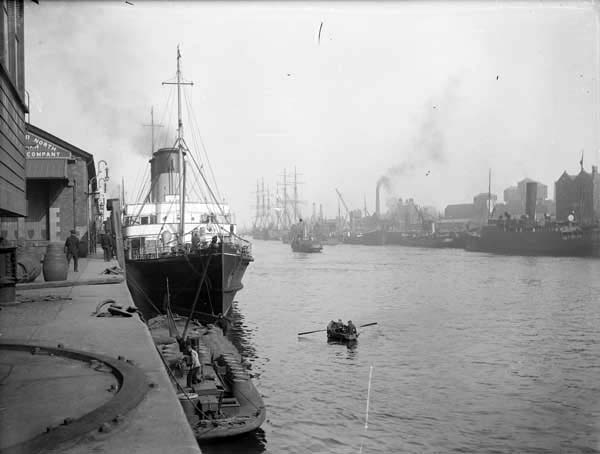
This photo of the North Wall shows some of the docks and ports along the eastern end of the Liffey. Photographed by Robert French between 1865 and 1914. From the National Library of Ireland's digitized Lawrence Photograph Collection.
This photo of the North Wall shows some of the docks and ports along the eastern end of the Liffey. Photographed by Robert French between 1865 and 1914. From the National Library of Ireland’s digitized Lawrence Photograph Collection.

Not technically a place, the Port and Docks, now simply known as Dublin Port, was originally established in 1707 as the Ballast Board and has been headquartered at various places along the Liffey according to the shoreline of the river’s mouth as it opens into the Irish Sea. The earliest ports in Dublin were associated with the Viking establishment centered at Dublin Castle, and the ports have moved continually downstream as a result of the management of the river’s banks with the building of the South Wall in 1715 and the Bull Wall on the north shore in 1842. By the time James Joyce referenced the Port and Docks as the employer of Gabriel’s father T.J. Conroy, they were an organization whose main industry and activity happened along the North Wall of the Liffey at the eastern edges of Dublin:

“They both kissed Gabriel frankly. He was their favourite nephew, the son of their dead elder sister, Ellen, who had married T.J. Conroy of the Port and Docks” (179).

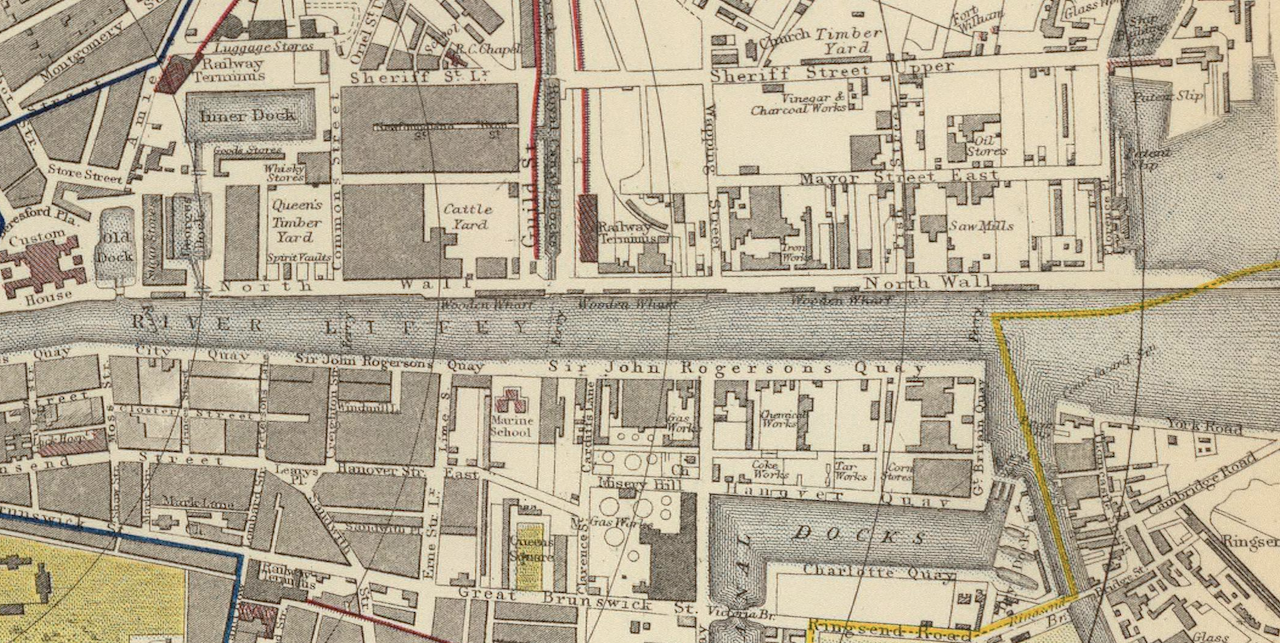
We never learn what T.J. Conroy did for the Port and Docks, “which was responsible for both the port of Dublin and for all the lighthouses around the Irish coast.” An 1883 Letts, Son, and Co. map shows the various yards, works, and buildings housed between the Custom House in the west and the mouth of the Liffey in the east.

A section of an 1883 Letts, Son, and Company map of Dublin showing the eastern end of Liffey between the Custom House and the river's mouth. Along the north bank are the main docks and port industrial complexes.
A section of an 1883 Letts, Son, and Company map of Dublin showing the eastern end of Liffey between the Custom House and the river’s mouth. Along the north bank are the main docks and port industrial complexes.

One of the Port and Docks’s preeminent figures was Bindon Blood Stoney, who began work at the Ballast Board (as it was then called until it was renamed in 1869) in 1856 as assistant to the chief engineer. He advanced quickly, and by 1862 he replaced his successor as chief engineer and began implementing a method he had been developing to convert half of the city’s quays to deepwater quays. According to the Dictionary of Irish Architects (linked above),

“Stoney described his method in a paper, ‘On the construction of harbour and marine works with artificial blocks of large size’, delivered to the Institution of Civil Engineers in London in 1874, which gained him the Institution’s Telford Medal and Premium for that year. The method was used for the extension of the North Quay and the construction of the Alexandra Basin and for the foundations of the North Bull lighthouse. Stoney also introduced a more efficient system for dredging the shipping channel within the harbour, designing hopper barges of unprecedented capacity to carry the dredgings out to sea. Other works which he designed included the rebuilding of Essex and Carlisle Bridges and the construction of the Beresford (or Butt) Swing Bridge. He also was reponsible for introducing a graduated pensions scheme for his workers.”

When Carlisle Bridge was rebuilt in 1876, it was renamed O’Connell Bridge, a bridge Gabriel and Gretta cross later in “The Dead” on their way to the Gresham Hotel after his aunts’ party in Usher Island, one of the westernmost quays along the Liffey. According to Dublin: The City within the Grand and Royal Canals and the Circular Road with the Phoenix Park, “[Stoney] virtually trebled the width of the bridge to match that of O’Connell Street, and levelled the approaches by substituting broad elliptical arches for the original semicircular spans” (694).

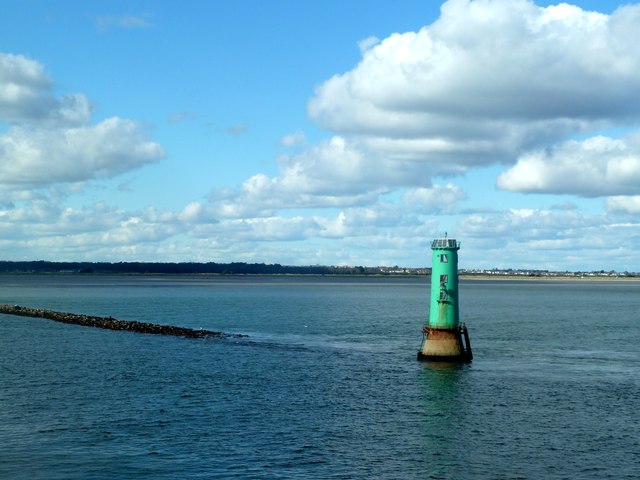
The North Bull Lighthouse, the foundation of which was constructed by Bindon Blood Stoney, chief engineer of the Dublin Port and Docks from 1862 to 1899. The North Bull Lighthouse (Graham Hogg) / CC BY-SA 2.0

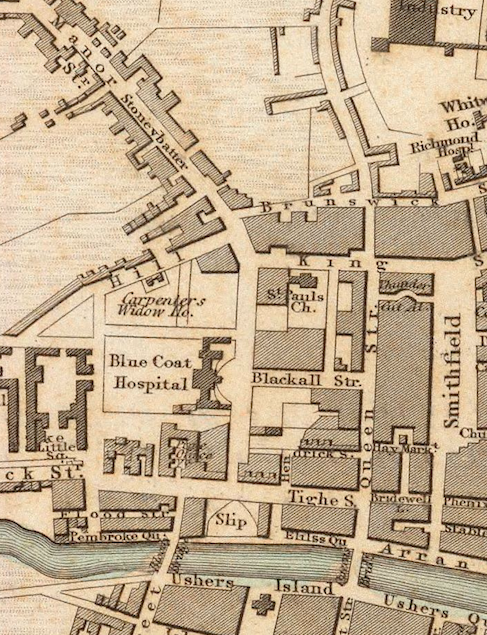
At the very least, because of Stoney, we know T.J. Conroy would probably have  a satisfactory pension from his time at the Port and Docks, and Gabriel and Gretta’s crossing of the Liffey would be smooth and, as the text verifies, uneventful other than the cab occupants’ observation of Daniel O’Connell’s statue as they emerge on the north side of the Liffey. It’s perhaps also worth noting that early in the same story, we learn that Gabriel’s aunts, before moving into the house where the story is mostly set in Usher’s Island, lived with their brother Pat in “Stoney Batter” (both pictured below), an area that is labelled Stoneybatter on both an 1836 and 1883 map. Since the name appears on an 1836 map of Dublin, though, it’s not likely that the area was named after Bindon Blood Stoney. Nevertheless, the combination of the story’s references to several quays, Stoney Batter, O’Connell Bridge, and the Port and Docks makes it impossible to not encounter Bindon Blood Stoney while researching these places.

A section of an 1836 map showing "Stoneybatter" (as opposed to "Stoney Batter" as indicated in "The Dead") just north of Usher's Island.
A section of an 1836 map showing “Stoneybatter” (as opposed to “Stoney Batter” as indicated in “The Dead”) just north of Usher’s Island.

Monkstown

Overhead tram lines are visible in this photograph of the square in front of the Monkstown Church of Ireland, photographed by Robert French between 1865 and 1914. From the digitized Lawrence Photograph Collection at the National Library of Ireland.

Monkstown, a suburb of Dublin, is approximately 6.5 miles (10.5 km) southeast of the city center. It sits on the coast of the Irish Sea, nearDún Laoghaire, which was Kingstown at the time James Joyce wrote “The Dead,” the only story in Dubliners that references Monkstown. In that final story of the collection, Monkstown is identified as the home of Gabriel and Gretta Conroy, the story’s main characters who are attending Kate and Julia Morkan’s annual Christmas-season dinner and musical exhibition:

“–Gretta tells me you’re not going to take a cab back to Monkstown tonight, Gabriel, said Aunt Kate” (180).

In The History of the County of Dublin, John D’Alton describes Monkstown as “a locality, not perhaps in itself either town or village, but surrounded by elegant villas, noble demesnes, and tasteful bathing lodges, and withal on the threshold of Kingstown” (864). This 1838 history, published in Dublin, chronicles, among other things, the establishment of Monkstown, an area known historically as Carrickbrennan. The earliest record D’Alton describes, in a style almost Finnegans-Wake-ean, is from 1174:

“In 1174 King Henry the Second, by charter, confirmed to the Abbey of the Blessed Virgin all their lands in Carrickbrennan, (the more ancient name of this locality,) Carrickvecon, &c., with all their appertenances, and all shipwrecks that might happen on their lands, together with soc and sac, tol and them, infangenthef and outfangenthef, and all liberties and free customs” (867).

After the sixteenth-century dissolution of the monasteries, much of the land of Monkstown, including three turrets, a monastery, orchard, abbey, and cemetery, were granted in 1546 to John Travers, Master of Ordnance. In 1638 the castle was built, and its ruins are still in tact. According to the Castle Hunter blog, which photographs and briefly describes many Irish ruins, this particular castle’s ruins, “sitting on the edge of a roundabout [, …] are the last thing you would expect to come across” in the area.

By 1640, through marriage and inheritance, Walter Cheevers had possession of most of these lands, but, according to D’Alton’s history, he was “indicted for adhering to the rebels in 1641” (869), and the Irish papist was exiled for a time to County Galway before being restored to his property in Monkstown. Thus, like Gretta in “The Dead,” who is from Galway, this Monkstown resident bridges west and east Ireland.

Monkstown Church, exterior, Monkstown, Co. Dublin. Photograph by Eason and Son, between 1900 and 1939. From the digitized Eason Photograph Collection at the National Library of Ireland. This is not the original abbey connected to the churchyard, but a rebuild of a church originally established in the area in 1789.

One of the primary historical features of Monkstown is its churchyard, which is the burial site for many shipwreck victims, including “the unfortunate officers and soldiers of the 97th Regiment, who perished in the … Rochdale transport-ship in 1807” (D’Alton 865).  The Rochdale, as well as the Prince of Wales, both crashed into the coastal rocks during a storm on November 18, 1807, and many of the wrecks’ victims washed onto shore in Monkstown. The wreck prompted the building of the nearby Kingstown Harbour (now Dún Laoghaire Harbour). In his description of the cemetery and its monuments, D’Alton cites Joseph Addison, who “on a similar occasion” of reading names on tombstones, commented “when I see kings lying by those who deposed them, when I consider rival wits placed side by side, or the holy men that divided the world with their contests and disputes, I reflect with sorrow and astonishment on the little competitions, factions, and debates of mankind” (qtd. in D’Alton 866). Like Gabriel at the end of “The Dead,” who imagines “the lonely churchyard on the hill where Michael Furey lay buried” and who watches the “snow falling faintly through the universe and faintly falling, like the descent of their last end, upon all the living and the dead” (223-24), D’Alton and Addison were struck by the smallness of humanity against the imposing monolith of history.

A train moving through Monkstown, 1880-1900. The photograph by Robert French is part of the Lawrence Photograph Collection at the National Library of Ireland,

Perhaps the most important historical developments for Monkstown was its railroad, which, in 1837, connected the area to the Dublin city-center and established it as a suburb of the city. The distance between the bustling center and the seaside neighborhood was now easily traversed. In fact, the young men in “After the Race” travel by train from Westland Row station to Kingstown, just a bit further from Dublin than Monkstown, “in a few seconds, as it seemed to Jimmy” (47). But by the time the Morkans’ party was winding down, the trains would most likely have stopped running, and according to late-nineteenth-century Eaton’s Diaries, trams only ran generally from about 8:30am to 11pm. The only method of transportation available to Gabriel and Gretta for a return home would have been a private cab.

Salthill Railway station, people, including girl with pram, Monkstown, Co. Dublin. Photographed between 1860 and 1883. From the digitized Stereo Pairs Photograph Collection at the National Library of Ireland.

But instead of taking a cab home after the party, the Conroys have reserved a room at the Gresham, a nice hotel in Sackville (now O’Connell) Street in the city center. The reason seems plain enough when Gabriel replies to Aunt Kate:

“–No, said Gabriel, turning to his wife, we had quite enough of that last year, hadn’t we? Don’t you remember, Aunt Kate, what a cold Gretta got out of it? Cab windows rattling all the way, and the east wind blowing in after we passed Merrion. Very jolly it was. Gretta caught a dreadful cold” (180).

Gabriel’s concerns are logical given the circumstances of time and place. Don Gifford notes that the story is set sometime between January 2 and 6, 1904 (Gifford 110), and a cab ride to Monkstown from Usher’s Island quay would have taken the couple along the coast for part of their journey, where the “east wind blowing in” would have been from the Irish Sea. Not only is it winter, it’s also very late when the party ends and the guests finally leave. In fact, it’s actually morning when Freddy Malins stands outside hailing cabs for the departing guests:

“The piercing morning air came into the hall where they were standing so that Aunt Kate said:

–Close the door, somebody. Mrs. Malins will get her death of cold” (206).

Once they’re all outside, the cold and dark of the scene are re-emphasized:

“The morning was still dark. A dull, yellow light brooded over the houses and the river; and the sky seemed to be descending. It was slushy underfoot; and only streaks and patches of snow lay on the roofs, on the parapets of the quay and on the area railings. The lamps were still burning redly in the murky air and, across the river, the palace of the Four Courts stood out menacingly against the heavy sky” (212-13).

Even though Monkstown was closer than ever before because of its connections to the city by train, tram, and cab; the late hour, the chill of the season, and even possibly the holiday transportation timetables keep the couple in the urban center even though their thoughts turn to remoter locations like Galway and the Aran Isles and the Shannon Waves and the “children… [and] household cares” in Monkstown (214).