Paris, France

The Seine River in Paris. The river was a fascination for Joyce, and he hybridized the Seine and the Liffey, among many others, in Finnegans Wake. Photo by Jasmine Mulliken 2014.

Paris, or France in general, only appears in three stories in Dubliners, but in those three stories, the references number 18. Here they are, in “After the Race:”

“Now and again the clumps of people raised the cheer of the gratefully oppressed. Their sympathy, however, was for the blue cars — the cars of their friends, the French.

The French, moreover, were virtual victors. Their team had finished solidly; they had been placed second and third and the driver of the winning German car was reported a Belgian. Each blue car, therefore, received a double measure of welcome as it topped the crest of the hill and each cheer of welcome was acknowledged with smiles and nods by those in the car. In one of these trimly built cars was a party of four young men whose spirits seemed to be at present well above the level of successful Gallicism: in fact, these four young men were almost hilarious” (42).


“Segouin was in good humour because he had unexpectedly received some orders in advance (he was about to start a motor establishment in Paris) and Riviere was in good humour because he was to be appointed manager of the establishment; these two young men (who were cousins) were also in good humour because of the success of the French cars” (43).


“They were not much more than acquaintances as yet but Jimmy found great pleasure in the society of one who had seen so much of the world and was reputed to own some of the biggest hotels in France” (43).


“The Frenchmen flung their laughter and light words over their shoulders and often Jimmy had to strain forward to catch the quick phrase” (44).


“At the control Segouin had presented him to one of the French competitors and, in answer to his confused murmur of compliment, the swarthy face of the driver had disclosed a line of shining white teeth. It was pleasant after that honour to return to the profane world of spectators amid nudges and significant looks” (44).


“Jimmy, whose imagination was kindling, conceived the lively youth of the Frenchmen twined elegantly upon the firm framework of the Englishman’s manner” (46).


“Riviere, not wholly ingenuously, undertook to explain to Jimmy the triumph of the French mechanicians” (46).


“They drank Ireland, England, France, Hungary, the United States of America. Jimmy made a speech, a long speech, Villona saying: “Hear! hear!” whenever there was a pause” (47).

“A Little Cloud:”

“–Go to London or Paris: Paris, for choice. That’d do you good. 
–Have you seen Paris?” (76)


“–It’s not so beautiful, you know. Of course, it is beautiful…. But it’s the life of Paris; that’s the thing. Ah, there’s no city like Paris for gaiety, movement, excitement….” (76)


“–Everything in Paris is gay, said Ignatius Gallaher. They believe in enjoying life — and don’t you think they’re right? If you want to enjoy yourself properly you must go to Paris. And, mind you, they’ve a great feeling for the Irish there” (77).


“–Tell me, he said, is it true that Paris is so… immoral as they say?

Ignatius Gallaher made a catholic gesture with his right arm.

–Every place is immoral, he said. Of course you do find spicy bits in Paris. Go to one of the students’ balls, for instance” (77).


“There’s no woman like the Parisienne — for style, for go” (77).

and “The Dead:”

“–Well, we usually go to France or Belgium or perhaps Germany, said Gabriel awkwardly” (189)

In the adolescence story, France is used as a general nationality for Jimmy Doyle’s friends, and in the maturity story, Paris insinuates the exotic, the unreachable, the intriguingly immoral opposite of Chandler’s existence in Dublin. In the public life story, France is mentioned “awkwardly,” in true Gabriel fashion, as he defends his increasingly apparent disinterest in Ireland to Molly Ivors. The author shared Gabriel’s tenuous relationship with the country, and it was this relationship that incited him exile himself to the continent prior to writing “The Dead.” Joyce lived in Paris for twenty years, but not until 1920, six years after the publication of Dubliners and sixteen years after the letter in which he announces that he was working on the “series of epicleti.” He had, however, spent time in Paris as a medical student, observing the “gaiety, movement, excitement” and spicy students’ balls to which Gallaher refers. And the movement and excitement  translate into the Futurist overtones of “After the Race,” a story based on the 1903 Gordon Bennett cup race in Ireland. Joyce had, earlier that same year, published his essay “The Motor Derby: Interview with the French Champion” in which he predicted that Henri Fournier would be a favorite in the July race.

Early film footage shows Joyce in the streets of the city he came to love and which he only left because of the invasion of the Nazis in 1940.

Holland

Screenshot of the Dubliners map showing Holland and Rotterdam (and the two Belgium references to the south from "After the Race" and "The Dead.")
Screenshot of the Dubliners map showing Holland and Rotterdam (and the two Belgium references to the south from “After the Race” and “The Dead.”)

Holland, which, technically, is a name referring only to two provinces of the Netherlands, appears in “A Painful Case” in rather a painful context. Its first mention is innocuous enough:

[Emily Sinico’s] husband was captain of a mercantile boat plying between Dublin and Holland; and they had one child. ()

But the second mention of the place, in the more specific instance of “Rotterdam,” reveals the sense of tragedy or despair that Joyce would come to associate with the country later in his life. According to the story, Mr. Sinico is in Rotterdam when he hears of his wife’s untimely death:

He was not in Dublin at the time of the accident as he had arrived only that morning from Rotterdam. ()

That Joyce has poor Mr. Sinico located in Holland when his wife is hit by a train is presciently appropriate given Joyce’s own string of unfortunate experiences in the country. David Pascoe describes these experiences in the introduction to the program for the XXIV International James Joyce Symposium (where Mapping Dubliners Project is giving a presentation this week) in Utrecht, Netherlands:

Joyce visited the Netherlands, on vacation, in the late spring of 1927…[H]e took in Zaandem (where, oddly, on visiting a small museum, and signing the visitors book, he stated his place of residence still as Dublin); The Hague (where he was attacked by a dog on the ‘wild and endless’ beach, at Scheveningen and broke his glasses); and Amsterdam (where, staying at the Hotel Krasnapolsky, he spent Bloomsday in bed with a cold, and, from his window, overlooking Dam Square, he saw a bolt of lightning strike the glorious Nieuwe Kerk).

The Dutch, like the British, had (and still have) their own colonies around the world, and Joyce would certainly have recognized it as another inescapable colonizing European force.

The Irish College in Rome

Father James Flynn, the priest who dies in “The Sisters” had been an important person in the narrator’s life. The priest had taught the young boy “a great deal,” including proper pronunciation of Latin, all about Napoleon, and the intricacies of the liturgical year and the mass. The narrator’s description of his informal education by the priest seems to also have been a Socratic one, for according to the boy,

“He had amused himself by putting difficult questions to me, asking what one should do in certain circumstance or whether such and such sins were mortal or venial or only imperfections. His questions showed me how complex and mysterious were certain institutions of the Church which I had always regarded as the simplest acts” (13).

Flynn himself had also been educated in all these areas, though his education was, of course, a formal one. In fact,

“He had studied in the Irish College in Rome…” (13)

The Irish College in Rome. Image from the college's website, http://www.irishcollege.org/
The Irish College in Rome. Image from the college’s website, http://www.irishcollege.org/

According to the history page on its website, The Irish College in Rome reopened in 1826 after having been closed for 28 years due to the French Invasion and the Napoleonic Wars.

When it finally reopened, it did so in a new location, since the old one had been lost “to some Sisters.” The reopening was led by Father Michael Blake of Dublin. Then, according to the history,

Within six years the two of the most famous Rectors of the College entered the pages of it’s [sic] history. Paul Cullen served as Rector for seventeen years, before going to Armagh as Archbishop and subsequently to Dublin as Archbishop and eventually as Ireland’s first Cardinal. He was succeeded by Tobias Kirby, a priest of the Diocese of Waterford and Lismore, who served as Rector for forty-one years from 1850 until he retired in 1891. The College archive contains his entire collection of letters, one of the most important private collections for the history of the nineteenth century in the English speaking world.”

(That archive is available online through the college’s website.)

Since he’s noted to have been 65 when he dies on July 1, 1895, Father Flynn would have been born in 1829 or 1830 and so would have attended the college well after its reopening, at the earliest, about 1850. This is the year Tobias Kirby became rector. Kirby died January 20, 1895, just under 6 months before Father Flynn. Like Joyce, Kirby returned to Dublin only twice after he left for the continent. According to the biographical summary accompanying the collection of Kirby’s letters housed at the college, “He maintained contacts with his ex-students some of whom were to become bishops in Australia.” Might one of these correspondents be the priest mentioned in Eveline, a school friend of her father’s who had moved to Melbourne?

All but one (Persia) of the geographical references in “The Sisters,” including the Irish College in Rome, pertain to Father Flynn. And only one of these is shared with the narrator: Great Britain Street. The street is where the Drapery is, where Flynn is lying in “the house of mourning” (14) and where the boy goes to visit. Five of the six total geographical references relate to the priest’s birth (Irishtown), education (Irish College in Rome), vocation (St. Catherine’s in Meath Street), unrealized plans (Johnny Rush’s), or death (Great Britain Street). The way this dead figure dominates the geography seems to anticipate the collection’s final story, wherein the dead continually exert their influence on the living.

St. Catherine’s

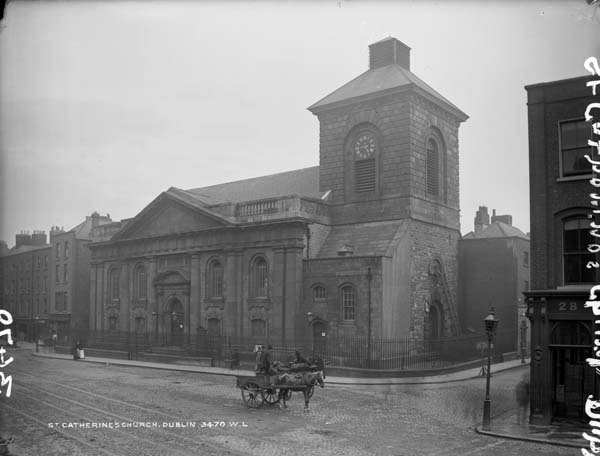
Father Flynn’s death notice reveals that he had been parish priest at St. Catherine’s Church in Meath Street:

“Two poor women and a telegram boy were reading the card pinned on the crape. I also approached and read:

July 1st, 1895

The Rev. James Flynn (formerly of S. Catherine’s Church,

in Meath Street), aged sixty-five years.

R.I.P.

The reading of the card persuaded me that he was dead and I was disturbed to find myself at check” (12).

The church is, of course, a Catholic church, and though it is on the site of a previous cathedral, the new church that took its place had only been completed as it would have appeared in the context of the story in 1857. It’s possible, then, given that he had been living with his sisters for several years since “something queer came over him,” that Father Flynn could have been its first priest (16). According to several editions of the Irish Catholic Directory and Almanac between 1858 and 1904, there were only two head parish priests in St. Catherine’s between the time the church was dedicated in 1858 and Father Flynn’s death in 1895.

Interior of St. Catherine's in Meath Street, photographed by Robert French between 1865 and 1914. Available through the National Library of Ireland's Lawrence Photograph Collection.
Interior of St. Catherine’s in Meath Street, photographed by Robert French between 1865 and 1914. Available through the National Library of Ireland’s Lawrence Photograph Collection.

The reference to the church in “The Sisters” carries implications of religious tension as well. A Catholic church designed by James Joseph McCarthy (though some would dispute this credit), who also designed the Star of the Sea Church around the same time, St. Catherine’s in Meath Street sits just around the corner from St. Catherine’s in Thomas Street, a Church of Ireland establishment where the Nationalist leader Robert Emmet was executed in 1803. Though Emmet was a Protestant, he supported Catholics’ freedom to worship. Thus even though the reference to St. Catherine’s is complicated by the two opposing denominations in near proximity to each other, even the tension is further complicated by the indirect evoking of Emmet whose political ideas were as important, if not more important, than his religious preferences.

St. Catherine's Church of Ireland in Thomas Street, photographed by Robert French between 1865 and 1914. Available through the National Library of Ireland's Lawrence Photograph Collection.
St. Catherine’s Church of Ireland in Thomas Street, photographed by Robert French between 1865 and 1914. Available through the National Library of Ireland’s Lawrence Photograph Collection.

In a story so seemingly centered on religious matters (simony [9], catechism [9, 13], the mysteries of the sacraments [13], Father Flynn, a mysterious fall from grace [16-18], etc.), the complex implications embedded in the reference to St. Catherine’s, just steps away from the other St. Catherine’s, coupled with the bookended references to Great Britain Street and Irishtown, the story’s first and last geographical references, respectively, suggest that, as usual with Joyce, there is much more at work in “The Sisters” than just religious mysteries and dichotomies. Religion is only part of a larger network of issues that, appropriately, the opening story of Dubliners invokes. And as Stephen reminds us later, in Ulysses, he is “servant of two masters…an English and an Italian” (U 17.638), meaning “[t]he imperial British state…and the holy Roman catholic and apostolic church” ((U 17.643-44). Religion is almost always tangled up with politics in Ireland, and seeing St. Catherine’s in Meath Street on a map, so close to Emmet’s execution site at St. Catherine’s in Thomas Street, helps to highlight the political overtones in the story, which, as it turns out, are just as prominent as the more literal religious ones.

Rutland Square

The first place mentioned in “Two Gallants,” Rutland Square (renamed Parnell Square in 1933 in honor of the Nationalist leader Charles Stewart Parnell who once lived there)  is situated in the north section of Dublin. It is bordered on northwest and southeast by Palace Row and Great Britain Street (now Parnell Street), and on southwest and northeast by Granby Row and Cavendish Row, which becomes Sackville Street (now O’Connell Street) south of Great Britain (Parnell) Street.

A section of the 1883 Letts, Son & Co. map, "Plan of the city of Dublin," showing Rutland Square. Made available by the David Rumsey Map Collection online.
A section of the 1883 Letts, Son & Co. map, “Plan of the city of Dublin,” showing Rutland Square. Made available by the David Rumsey Map Collection online.

The central feature of Rutland Square is the Rotunda Gardens just behind the maternity, or “lying-in,” hospital. The gardens were established by Bartholemew Mosse, who also established the hospital itself, according to an 1821 history by George Newenham Wright,

“for the purpose of holding Sunday evening promenades, for the benefit of that establishment. Those entertainments were continued for many years, to the great advantage of the funds of the hospital, until the Association for discountenancing Vice petitioned the governors of the charity to suppress this immoral proceeding; since which the gardens have only been opened on the other evenings in the week during the summer season: on those occasions, one and sometimes two military bands attend, and play from eight to ten o clock, while the persons admitted promenade along a terrace in front of the orchestra, eighteen perches in length; the walk round the entire square, inside, measures 1 fur. 35 per. The interior, which is thickly planted with full grown elms and close underwood, on promenade evenings is brilliantly illuminated with festoons of variegated lamps and other fanciful decorations; and lately, singers have been introduced to amuse in the intervals between the different airs called for by the visiters.–The receipts of one evening, at this place of amusement, have been known to amount to upwards of 20 l. which is an enormous sum, if we consider the moderate price of admission, five pence each” (203).

Rotunda Gardens, photographed by Robert French, between 1865 and 1914. Available via the Lawrence Photograph Collection, online at the National Library of Ireland.

Donald Torchiana argues that this geographical reference is the first of many that “demonstrate just how clearly the mirror of ‘Two Gallants’ reflects the historic pomp and grandeur of Ascendency treacheries that cast long shadows behind the otherwise mean and stunted posturings of Corley and Lenehan near the end of Irish enslavement” (115). Torchiana surveys many of the geographic references in the story through the lens of their allusive potentials to the political vitriol of the Irish-English relationship. He points out that Rultand Square, for example, was named after the fourth Duke of Rutland, Charles Manners, in 1791, and identifies the duke as “an altogether too convivial Lord Lieutenant” (118).

Facing the square, on the surrounding streets, were, as Wright describes them, “noble structures; amongst them…[the homes] of Lord Charlemont…, Lord Wicklow, Lord Longford, the Countess of Ormond, the Earl of Bective, the Earl of Farnham, and several others” (264).

Charlemont House, engraving by James Malton, 1793, via National Library of Ireland.

In the later part of the nineteenth century, the square became a vibrant political center. Parnell held his first public meeting and made his last public speech at the Rotunda Ballroom in Rutland Square. The decades leading up to Irish independence necessarily saw plenty of action in the square due to its proximity, for example, to the General Post Office, which figures so prominently in the Easter Rising. Many streets and landmarks changed after independence, several of them located in the immediate area of the square. The square itself became Parnell Square; part of the gardens became the Gardens of Remembrance, commemorating all who gave their lives for Irish independence; Great Britain Street became Parnell Street, where a statue of the iconic figure stands; and Sackville Street, named for Lionel Sackville, the first duke of Dorset, was renamed O’Connell Street, after Daniel O’Connell.

In “Two Gallants,” the square serves as the beginning of the long circuitous route the story contains:

“Two young men came down the hill of Rutland Square. One of them was just bringing a long monologue to a close. The other, who walked on the verge of the path and was at times obliged to step on to the road, owing to his companion’s rudeness, wore an amused listening face” (49).

The two men make their way to Stephen’s Green and Lenehan agrees to meet up with Corley later that evening in Merrion Street. When Corley is gone, Lenehan doubles back along their previous route, once again reaching Rutland Square:

“He turned to the left when he came to the corner of Rutland Square and felt more at ease in the dark quiet street, the sombre look of which suited his mood” (56-57).

The reboot, as it were, back to the beginning location, aside from all the location’s political implications, signals an alternate reality for Lenehan. Now that he is back at the story’s opening location, he has a chance to follow another path, to make different decisions. And indeed his path begins with a turn to the left, and it’s marked by “dark,” “quiet,” and “sombre” qualities, as opposed to the loudness and tedious attentiveness marked by the original journey’s beginning. Instead of walking down Sackville Street with his friend, he moves west, along Great Britain Street (assuming that the corner referred to is the southern corner, the first corner of the square he would have reached as he approached from the south), a street that also takes us back to the opening of “The Sisters.” Not only in the return to Rutland Square a reboot for Lenehan, an opportunity to re-initiate a journey of his own, it is also a potential return to the childhood state, as Great Britain Street is the very first geographical reference in the childhood section of Dubliners. 

Lenehan’s thoughts present the possibility of a fresh start as he continues along his new route. He even imagines how life might be if he settled down. He doubts his friend’s ability to achieve his goal with the girl. But ultimately, he finds his way back to Stephen’s Green where he left Corley. Even after attempting an alternate route, he ends up in the same place. What the map illustrates is yet another of Joyce’s models of paralysis. Despite the various roads and the squares, the circles and the doubling-back, the destination is inevitable.


Earl Street

Earl Street. photograph by Robert French from National Library of Ireland's digitized Lawrence Collection at http://catalogue.nli.ie/Record/vtls000040954
Earl Street. photograph by Robert French from National Library of Ireland’s digitized Lawrence Collection at http://catalogue.nli.ie/Record/vtls000040954

Earl Street is situated on the north side of the Liffey in the heart of Dublin. It runs from O’Connell Street on the west to Marlborough Street on the east. The street is mentioned in passing by Corley in “Two Gallants:”

“She’s on the turf now. I saw her driving down Earl Street one night with two fellows with her on a car” (53).

Corley is referring to an old sweetheart who he recalls “was…a bit of all right.” She had been, apparently, the only girl Corley ever “got [anything] out of,” and he mentions her “regretfully” when he speaks of her to Lenehan.

That “[s]he’s on the turf now” essentially means she’s a prostitute, and as it happens, Earl Street is only a couple blocks away from what was, in Joyce’s day, the red light district. Called “Monto,” short for Montgomery Street which was the heart of the district, the area features famously in the Circe episode of Ulysses. If Corley’s friend was on a car with two gentlemen heading east on Earl Street, she may very well indeed have been heading for the Monto.

One other Dubliners character visits Earl Street, though the street’s name is never mentioned. Maria, in “Clay,” breaks up her trip to Joe’s by stopping at the Pillar so she can “ferret” into Downes’s cakeshop for penny cakes (102). She isn’t able to buy plumcake there, so she heads back west up Earl Street (the opposite direction of Corley’s friend) to cross O’Connell Street and see if she can find plumcake in Henry Street.

Maria’s trajectory along Earl Street is in opposition to Corley’s girlfriend-turned-prostitute, and the fact that she’s buying cakes instead of riding on a car with not just one but two men, speaks to what decisions she may have faced and made regarding relationships and vocation. Did she ever go out with a Corley? Is she a version of one of the many girls Corley went with who didn’t give him anything in return for “tak[ing] them out…on the tram somewhere and pay[ing] the tram or tak[ing] them to a band or a play at the theatre or buy[ing] them chocolate and sweets or something in that way” (52)? The visual cartographic aspects of the two women’s routes adds yet another layer to the divergence of life paths and possible timelines that so many of the characters of Dubliners are faced with.

It may also be worth noting that Earl Street is the location of the famous “Prick with the stick” statue of James Joyce.

Statue of James Joyce in Earl Street. Nicknamed by locals "Prick with a Stick," the statue was erected in 1990.
Statue of James Joyce in Earl Street. Nicknamed by locals “Prick with a Stick,” the statue was erected in 1990.

Melbourne

“Eveline,” a story with only three specific references to Dublin locations, contains a total of ten geographical references. The remaining references span four continents, a scale that ultimately renders Dublin very small indeed, if not altogether constricting. Eveline is surrounded by reminders of her potential escape, from the world traveller Frank himself, to the new development across the street, which recalls friends long since departed for England, to the “yellowing photograph” of her father’s friend the priest who “is in Melbourne now” (37).

St. Patrick's Cathedral, the first Catholic church in Melbourne, Australia. Construction of the cathedral began in 1958, and though the nave was completed within ten years, the rest of the structure was only finally completed in 1939.
St. Patrick’s Cathedral, the first Catholic church in Melbourne, Australia. Construction of the cathedral began in 1958, and though the nave was completed within ten years, the rest of the structure was only finally completed in 1939.

Melbourne, in Victoria, Australia, is even further away from Dublin than Buenos Ayres. But like Buenos Ayres, it was seeing a boom of Irish immigration during the later half of the nineteenth century. Prior to this period, many of those who embarked on the journey to Australia were prisoners, sailing for the many penal colonies on the far-away continent. Some of these prisoners were even Irish priests, implicated in crimes ranging from murder to support of the 1798 rebellion. Three priests in particular were sent as convicts to the penal settlements: Fathers Dixon, Harold, and O’Neill. O’Neill, who had been falsely accused of murder, was released and returned to Ireland when his innocence was demonstrated in less than month, and the other two were released in 1803 and allowed to “exercise [their] clerical functions” in Australia, “a place,” according to James Francis Hogan in The Irish in Australia, “where they were so sadly needed” (228).

Patrick Bonaventue Geoghegan, from Dublin, was the first resident priest in Melbourne and became the second Bishop of Adelaide after his predecessor Francis Murphy (Hogan 254). Murphy and Geoghegan were two of many priests, along with James Goold, appointed the first Bishop of Melbourne in 1848 and responsible for the establishment and building of St. Patrick’s Cathedral in Melbourne, who were recruited by Dr. William Ullathorne, English Catholic prelate, who wrote The Catholic Mission in Australasia (London, 1837) and made it his mission to strengthen the Catholic clerical presence there. Most of his success was with the Irish rather than the English, however, leading him to feel that “ecclesiastically Australia must become a colony of Ireland.” 

But these first Catholic priests in Australia were too old to be “school friend[s]” of Eveline’s father. By Eveline’s father’s coming of age, priests were not only increasingly welcome in Australia; many were eagerly volunteering to dedicate their lives to serving a growing Irish and Catholic population in what was then termed “the antipodes.” A pastoral letter of 1885, composed by the “Bishops of Australasia,” summarized the state of their faith in that place thusly:

“At a date so recent as to be quite within the lifetime of men still moving among us, there was not one priest, or one single altar, in all these southern lands.” (qtd. in Hogan 263)

But by 1885 that all had changed as result of men like the one in the yellowing photograph who fought the apparent discrimination against Catholicism to erect a thriving institution. By 1888, when Hogan’s account was published, “the priests in the colonies number[ed] several hundreds; the churches [we]re among the most beautiful in Christendom…Such a contrast between the beginning and the close of a century is unexampled in history” (264).

The Dodder

Although the word “water” is only mentioned once, there is a kind of fluidity seeping through the landscape of “An Encounter.” Based partly on an experience shared by James Joyce and his brother Stanislaus, the story chronicles a day’s truancy for the narrator and his friend Mahony who, instead of going to school, wander Dublin, observing the city’s workers, non-school-going children, and eventually its seedier inhabitants as represented by the josser.

[The Dodder River, Dublin], photographed by Robert French between 1880 and 1900, made available by the National Library of Ireland as part of the Lawrence Photograph Collection.
[The Dodder River, Dublin], photographed by Robert French between 1880 and 1900, made available by the National Library of Ireland as part of the Lawrence Photograph Collection.
Over the course of their journey they encounter several bodies of water, including the three largest rivers in Dublin: the Liffey, the Tolka, and the Dodder. The boys start at the Royal Canal, which runs around the city’s general perimeter north of the Liffey. Then they walk up to the Tolka and follow its south bank until they reach the area of the Liffey ‘s docks. The Tolka issues into the Dublin Bay north of the Liffey, but the boys turn southward toward the larger river. They cross the Liffey on a ferryboat, the narrator gazing out toward the Irish Sea, and then wander through Ringsend, finally settling on a sloping bank near the Dodder:

“We both felt rather tired and when we reached the field we made at once for a sloping bank over the ridge of which we could see the Dodder” (24).

The Dodder happens to figure rather erotically in Joyce’s own experiences with Nora, explains Chester Anderson in his “Joyce’s Letters and His Use of ‘Place’.” According to letters, Joyce questions Nora about her relationship with a friend of his whom she “went with…down to the bank of the Dodder.” Joyce then demands:

“Tell me. When you were in that field near the Dodder . . . were you lying down when you kissed? Did you place your hand on him as you did on me in the dark . . .?” (Letters II 232)

Anderson notes also that “in one of the portions of the letter of December 3, 1909, which is not printed in Ellmann’s text, Joyce writes in great detail (in order to excite himself and Nora) about their first sexual act five years before ‘at Ringsend,’ when, he says, he ‘came off’ through her fingers” (qtd. in Anderson 69). Anderson even suggests that “the ‘queer old josser’ (pidgin English for God) is both the Dublin god and one image of the self of the narrator as he might become in Dublin.”

Thus, a story that begins as a partial reference to Joyce’s childhood ends with a much more maturely tinged reference to his sexual life. This autobiographical fluidity of reference adds yet another example of the transition from childhood to adolescence which already figures in the story. And geographically, the transition takes the form of waters flowing toward the Liffey: the Royal Canal from the north side of the Liffey, where all the childhood stories take place or at least begin, and the Dodder from the south, where childhood innocence is challenged by  less familiar images and ideas, in this story as well as in “Araby.”

Buenos Ayres

In “Eveline,” the title character has the chance to leave Dublin with Frank, her love, to his new home in Buenos Ayres. In the story, she weighs the pros and cons of leaving her father and siblings and a hard life of working and caretaking for the exciting unknown of a new country where she will be free to establish a new identity as Frank’s “Poppens.”

Paseo Colon, Buenos Aires
Paseo Colon, Buenos Aires, photographed in 1915. The photo is from a historic lecture booklet with the description “On leaving the docks and driving up into the city, the visitor is at once impressed with the fact that Buenos Aires is not so wholly wrapped up in the purely material as is our commercial center on Lack Michigan. It has broadened along more aesthetic lines and is cultivating the graces, not alone the sordid features, of cosmopolitanism. In the newer parts, the buildings and shaded boulevards and beautifully landscaped parks resemble rather those of Paris; although it is not behind our own big cites in public utilities.” Photo is part of the Visual Instruction Department Lantern Slides Collection at the University of Oregon, http://oregondigital.org/u?/archives,3953

The city, which is the capital of Argentina, is named three times in the story:

“She was to go away with him by the night-boat to be his wife and to live with him in Buenos Ayres where he had a home waiting for her” (38).

“He had fallen on his feet in Buenos Ayres, he said, and had come over to the old country just for a holiday” (39).

“If she went, tomorrow she would be on the sea with Frank, steaming towards Buenos Ayres” (40).

The city is alluring to her, exotic and promising, yet it also stirs up trepidation. When, at the end of the story, she’s faced with boarding the ship, “all the seas of the world tumble[…] about her heart” and she fears that “[Frank] would drown her” (41). She grasps the railing and does not board. She seems to fear not only the uncertainty of a future with Frank but also the expanse of the globe.

Though the common spelling of the city’s name is “Buenos Aires,” Joyce’s alternate spelling draws attention to the etymology of the name, which is derived from Our Lady of Buen Ayre (“fair winds”), which would guide the sailors coming and going from this port city. Not only is the city’s name a fortuitous one for a sailor like Frank, the city itself was also a popular emigration destination for Europeans from 1850 to 1914. According to Sidney Freshbach’s JJQ article “‘Fallen on His Feet in Buenos Ayres’ (D 39): Frank in ‘Eveline,'” the year Joyce wrote the story, “an economic boom began, lasting till 1912, and, for the decade 1901-1910, migration shot up again to 12,585” (224). Eveline has the chance to become just one of many Europeans, which included the Irish, that made a fresh start in the thriving South American city.

Yet for better or for worse, she chooses not to go. Contradicting the example set by other characters in the story like the priest who had moved to Melbourne and her neighbors, the Waters, who had moved to England, Eveline decides in a moment not “to go away like the others, to leave her home” (37).

South Circular Road

The South Circular was, during the late 19th and early 20th centuries, essentially the southern border of Dublin. Most of the development along the road was residential and took place in the 19th century. As an outer-edge area, it would have been a somewhat less expensive, yet newer, more attractive, nearly suburban place to live for many families, and it appears to be the locale of several of Corley’s old flames in “Two Gallants:”

“–First I used to go with the girls, you know, said Corley, unbosoming; girls off the South Circular. I used to take them out, man, on the tram somewhere and pay the tram or take them to a band or a play at the theatre or buy them chocolate and sweets or something that way. I used to spend money on them right enough, he added, in a convincing tone, as if he were conscious of being disbelieved” (52).

Unlike the North Circular Road, which was somewhat upper-middle-class, the South Circular was slightly less posh and was even home to Richmond House of Corrections which became the military Wellington Barracks, pictured below, in 1887.

Wellington Barracks, photographed by Robert French between 1887 and 1914. Courtesy of the National Library of Ireland's Lawrence Photograph Collection.
Wellington Barracks, photographed by Robert French between 1887 and 1914. Courtesy of the National Library of Ireland’s Lawrence Photograph Collection.

Don Gifford notes that the road “was a popular promenade for groups of unattached lower-middle-class young women” (58). The girls on the South Circular would most likely be young women, perhaps very like Eveline, living at home with their parents, perhaps inexperienced at romance and gullible to the “charms” of someone like Corley. Yet even after he spent money on pampering them, only one, who “was…a bit of all right” (53) gave him anything in return for his troubles. And she, according to Corley, later became a prostitute.

This photograph, from the Griffith College website, shows a "[v]iew of bomb damage on the South Circular Road, January 1941, taken from behind the Griffith Barracks' railings. (Courtesy of the National Library of Ireland)."
This photograph, from the Griffith College website, shows a “[v]iew of bomb damage on the South Circular Road, January 1941, taken from behind the Griffith Barracks’ railings. (Courtesy of the National Library of Ireland).”
Although taken in January 1941 after it was bombed, the photograph above shows a row of residences in South Circular Road, which are representative of the types of buildings that lined the street.

It’s also worth noting that in Ulysses, we learn that Bloom would wander along the South Circular Road, between Leonard’s Corner and Synge Street, with Owen Goldberg and Cecil Turnbull in 1884. The area around Portobello and the South Circular was home, in fact, to many Jews who had left Lithuania in the nineteenth century.