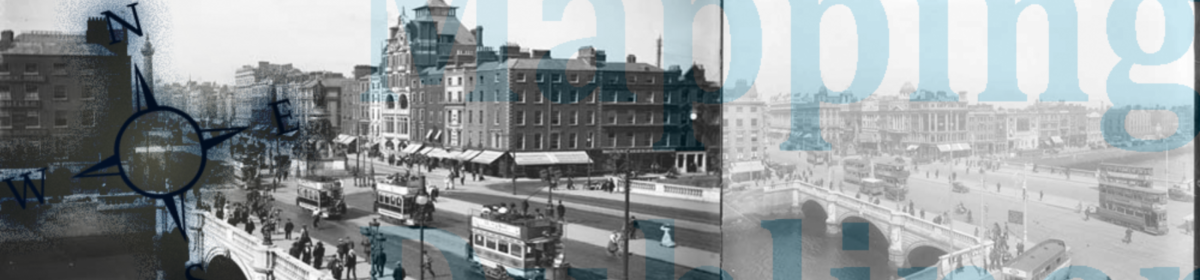
Dame Street

Dame Street, facing east toward Trinity College. Photographed between 1865 and 1914 by Robert French, part of the Lawrence Photograph Collection at the National Library of Ireland.

Referenced in two of the Dubliners adolescence stories, Dame Street is one of the largest thoroughfares in the city. Today, as in Joyce’s day, the street houses City Hall on the western end and Trinity College at the Eastern end. In between is still the city’s financial district, featuring the Bank of Ireland, several insurance and accounting firms, and high-end retailers. One of these retailers, Waterhouse’s, is referenced directly in “Two Gallants.” Don Gifford describes it as “goldsmiths and silversmiths, jewelers, and watchmakers” (Gifford 57).

Lipton's Premises in Dame Street, photographed 13 October 1890 by James Talbot-Power. From the National Library of Ireland.
Lipton’s Premises in Dame Street, photographed 13 October 1890 by James Talbot-Power. From the National Library of Ireland.

The National Library of Ireland’s photo collection also reveals the Lipton company was in the process of opening a store in Dame Street in 1890, and an American publication, The Book-Keeper: The Business Man’s Magazine, features a 1904 article on the company in which they describe this second Dublin location:

One of the Lipton stores is located at the corner of Dame and St. George’s streets, only a few steps from Pim Brothers’ great department store. The Dame street store is in the very heart of the business district frequented by fashionable and middle class purchasers. (St. Clair  25)

Dame Street serves as the energetic setting for the race cars’ entrance to the city center in “After the Race:”

They drove down Dame Street. The street was busy with unusual traffic, loud with the horns of motorists and the gongs of impatient tram-drivers. Near the Bank Segouin drew up and Jimmy and his friend alighted. A little knot of people collected on the footpath to pay homage to the snorting motor. The party was to dine together that evening in Segouin’s hotel and, meanwhile, Jimmy and his friend, who was staying with him, were to go home to dress. The car steered out slowly for Grafton Street while the two young men pushed their way through the knot of gazers. They walked northward with a curious feeling of disappointment in the exercise, while the city hung its pale globes of light above them in a haze of summer evening. (45)

The cars would have been moving west to east. The bank (pictured below) is at the east end of Dame Street, just across from Trinity College, and it is here where Jimmy Doyle and Villona, his Hungarian friend, hop out of the car and make their way to Jimmy’s house. Walking north from the bank, they would be on Westmoreland Street heading toward Temple Bar and the Liffey. Where Jimmy lives is never stated, but since he has money, unlike the children in the previous set of stories who live well north of the Liffey, it’s reasonable to assume Jimmy lives nearby, on the south side of the river.

Bank of Ireland, at the corner of Dame Street and Westmoreland Street. Just to the right, not pictured) is Trinity College. Photographed by Robert French between 1880 and 1900. From the Lawrence Photograph Collection at the National Library of Ireland.

The bustling Dame Street setting of this story’s opening is appropriate to the tone of Futurism and thriving economy that characterizes the majority of “After the Race.” In “Two Gallants,” the street takes on a more contradicting, even out-of-place, implication. It’s first mentioned as the street in which Corley initially met the girl whom he is about to appeal to for money:

“And where did you pick her up, Corley?” he asked.

Corley ran his tongue swiftly along his upper lip.

“One night, man,” he said, “I was going along Dame Street and I spotted a fine tart under Waterhouse’s clock and said good-night, you know. So we went for a walk round by the canal and she told me she was a slavey in a house in Baggot Street. I put my arm round her and squeezed her a bit that night. Then next Sunday, man, I met her by appointment. We went out to Donnybrook and I brought her into a field there. She told me she used to go with a dairyman…. It was fine, man. Cigarettes every night she’d bring me and paying the tram out and back. And one night she brought me two bloody fine cigars—O, the real cheese, you know, that the old fellow used to smoke…. I was afraid, man, she’d get in the family way. But she’s up to the dodge.”

This girl, who works in the upper-class Baggot Street area and hangs out at night outside of Dame Street jewelry stores is, even though a “slavey,” quite better off than Corley. It’s a wonder how he was able to “pick her up” at all, and this remains one of the mysteries of the story. The street appears again as Lenehan wanders solitary through the city waiting for his friend to finish with the girl:

He went into Capel Street and walked along towards the City Hall. Then he turned into Dame Street. At the corner of George’s Street he met two friends of his and stopped to converse with them. He was glad that he could rest from all his walking. His friends asked him had he seen Corley and what was the latest. He replied that he had spent the day with Corley. His friends talked very little. They looked vacantly after some figures in the crowd and sometimes made a critical remark.

Though the text doesn’t point it out, at the corner of Capel and Dame, just across the street from City Hall, sits Watherhouse’s. That the geographic marker worth noting is City Hall, and not the previously-mentioned Waterhouse, could be indicative of Lenehan’s growing resentment toward Corley. Just prior to Lenehan’s arrival at this corner, he has been pondering his own failures, a rumination brought on by imagining Corley and his girl:

When he had eaten all the peas he sipped his ginger beer and sat for some time thinking of Corley’s adventure. In his imagination he beheld the pair of lovers walking along some dark road; he heard Corley’s voice in deep energetic gallantries and saw again the leer of the young woman’s mouth. This vision made him feel keenly his own poverty of purse and spirit. He was tired of knocking about, of pulling the devil by the tail, of shifts and intrigues. He would be thirty-one in November. Would he never get a good job? Would he never have a home of his own?

Corley clearly represents to Lenehan his own shortcomings, and his focus on City Hall instead of Waterhouse as he turns this corner could signify his unconscious, or even conscious, desire to break with Corley, who he may imagine is holding him back. But in the end, of course, he meets his friend, and nothing seems to change.

The section of Dame Street between Capel and George’s streets also serves as the beginning of a gnomon in Lenehan’s squarish route. It is here where we get a visually discernible parallel to the feeling of emptiness he has just experienced. More on the route’s gnomon can be found in “Two Gallants” Route.

The lines forming the route of Corley and Lenehan, then Lenehan alone, in "Two Gallants."
The lines forming the route of Corley and Lenehan, then Lenehan alone, in “Two Gallants.”

Rutland Square

The first place mentioned in “Two Gallants,” Rutland Square (renamed Parnell Square in 1933 in honor of the Nationalist leader Charles Stewart Parnell who once lived there)  is situated in the north section of Dublin. It is bordered on northwest and southeast by Palace Row and Great Britain Street (now Parnell Street), and on southwest and northeast by Granby Row and Cavendish Row, which becomes Sackville Street (now O’Connell Street) south of Great Britain (Parnell) Street.

A section of the 1883 Letts, Son & Co. map, "Plan of the city of Dublin," showing Rutland Square. Made available by the David Rumsey Map Collection online.
A section of the 1883 Letts, Son & Co. map, “Plan of the city of Dublin,” showing Rutland Square. Made available by the David Rumsey Map Collection online.

The central feature of Rutland Square is the Rotunda Gardens just behind the maternity, or “lying-in,” hospital. The gardens were established by Bartholemew Mosse, who also established the hospital itself, according to an 1821 history by George Newenham Wright,

“for the purpose of holding Sunday evening promenades, for the benefit of that establishment. Those entertainments were continued for many years, to the great advantage of the funds of the hospital, until the Association for discountenancing Vice petitioned the governors of the charity to suppress this immoral proceeding; since which the gardens have only been opened on the other evenings in the week during the summer season: on those occasions, one and sometimes two military bands attend, and play from eight to ten o clock, while the persons admitted promenade along a terrace in front of the orchestra, eighteen perches in length; the walk round the entire square, inside, measures 1 fur. 35 per. The interior, which is thickly planted with full grown elms and close underwood, on promenade evenings is brilliantly illuminated with festoons of variegated lamps and other fanciful decorations; and lately, singers have been introduced to amuse in the intervals between the different airs called for by the visiters.–The receipts of one evening, at this place of amusement, have been known to amount to upwards of 20 l. which is an enormous sum, if we consider the moderate price of admission, five pence each” (203).

Rotunda Gardens, photographed by Robert French, between 1865 and 1914. Available via the Lawrence Photograph Collection, online at the National Library of Ireland.

Donald Torchiana argues that this geographical reference is the first of many that “demonstrate just how clearly the mirror of ‘Two Gallants’ reflects the historic pomp and grandeur of Ascendency treacheries that cast long shadows behind the otherwise mean and stunted posturings of Corley and Lenehan near the end of Irish enslavement” (115). Torchiana surveys many of the geographic references in the story through the lens of their allusive potentials to the political vitriol of the Irish-English relationship. He points out that Rultand Square, for example, was named after the fourth Duke of Rutland, Charles Manners, in 1791, and identifies the duke as “an altogether too convivial Lord Lieutenant” (118).

Facing the square, on the surrounding streets, were, as Wright describes them, “noble structures; amongst them…[the homes] of Lord Charlemont…, Lord Wicklow, Lord Longford, the Countess of Ormond, the Earl of Bective, the Earl of Farnham, and several others” (264).

Charlemont House, engraving by James Malton, 1793, via National Library of Ireland.

In the later part of the nineteenth century, the square became a vibrant political center. Parnell held his first public meeting and made his last public speech at the Rotunda Ballroom in Rutland Square. The decades leading up to Irish independence necessarily saw plenty of action in the square due to its proximity, for example, to the General Post Office, which figures so prominently in the Easter Rising. Many streets and landmarks changed after independence, several of them located in the immediate area of the square. The square itself became Parnell Square; part of the gardens became the Gardens of Remembrance, commemorating all who gave their lives for Irish independence; Great Britain Street became Parnell Street, where a statue of the iconic figure stands; and Sackville Street, named for Lionel Sackville, the first duke of Dorset, was renamed O’Connell Street, after Daniel O’Connell.

In “Two Gallants,” the square serves as the beginning of the long circuitous route the story contains:

“Two young men came down the hill of Rutland Square. One of them was just bringing a long monologue to a close. The other, who walked on the verge of the path and was at times obliged to step on to the road, owing to his companion’s rudeness, wore an amused listening face” (49).

The two men make their way to Stephen’s Green and Lenehan agrees to meet up with Corley later that evening in Merrion Street. When Corley is gone, Lenehan doubles back along their previous route, once again reaching Rutland Square:

“He turned to the left when he came to the corner of Rutland Square and felt more at ease in the dark quiet street, the sombre look of which suited his mood” (56-57).

The reboot, as it were, back to the beginning location, aside from all the location’s political implications, signals an alternate reality for Lenehan. Now that he is back at the story’s opening location, he has a chance to follow another path, to make different decisions. And indeed his path begins with a turn to the left, and it’s marked by “dark,” “quiet,” and “sombre” qualities, as opposed to the loudness and tedious attentiveness marked by the original journey’s beginning. Instead of walking down Sackville Street with his friend, he moves west, along Great Britain Street (assuming that the corner referred to is the southern corner, the first corner of the square he would have reached as he approached from the south), a street that also takes us back to the opening of “The Sisters.” Not only in the return to Rutland Square a reboot for Lenehan, an opportunity to re-initiate a journey of his own, it is also a potential return to the childhood state, as Great Britain Street is the very first geographical reference in the childhood section of Dubliners. 

Lenehan’s thoughts present the possibility of a fresh start as he continues along his new route. He even imagines how life might be if he settled down. He doubts his friend’s ability to achieve his goal with the girl. But ultimately, he finds his way back to Stephen’s Green where he left Corley. Even after attempting an alternate route, he ends up in the same place. What the map illustrates is yet another of Joyce’s models of paralysis. Despite the various roads and the squares, the circles and the doubling-back, the destination is inevitable.


Earl Street

Earl Street. photograph by Robert French from National Library of Ireland's digitized Lawrence Collection at http://catalogue.nli.ie/Record/vtls000040954
Earl Street. photograph by Robert French from National Library of Ireland’s digitized Lawrence Collection at http://catalogue.nli.ie/Record/vtls000040954

Earl Street is situated on the north side of the Liffey in the heart of Dublin. It runs from O’Connell Street on the west to Marlborough Street on the east. The street is mentioned in passing by Corley in “Two Gallants:”

“She’s on the turf now. I saw her driving down Earl Street one night with two fellows with her on a car” (53).

Corley is referring to an old sweetheart who he recalls “was…a bit of all right.” She had been, apparently, the only girl Corley ever “got [anything] out of,” and he mentions her “regretfully” when he speaks of her to Lenehan.

That “[s]he’s on the turf now” essentially means she’s a prostitute, and as it happens, Earl Street is only a couple blocks away from what was, in Joyce’s day, the red light district. Called “Monto,” short for Montgomery Street which was the heart of the district, the area features famously in the Circe episode of Ulysses. If Corley’s friend was on a car with two gentlemen heading east on Earl Street, she may very well indeed have been heading for the Monto.

One other Dubliners character visits Earl Street, though the street’s name is never mentioned. Maria, in “Clay,” breaks up her trip to Joe’s by stopping at the Pillar so she can “ferret” into Downes’s cakeshop for penny cakes (102). She isn’t able to buy plumcake there, so she heads back west up Earl Street (the opposite direction of Corley’s friend) to cross O’Connell Street and see if she can find plumcake in Henry Street.

Maria’s trajectory along Earl Street is in opposition to Corley’s girlfriend-turned-prostitute, and the fact that she’s buying cakes instead of riding on a car with not just one but two men, speaks to what decisions she may have faced and made regarding relationships and vocation. Did she ever go out with a Corley? Is she a version of one of the many girls Corley went with who didn’t give him anything in return for “tak[ing] them out…on the tram somewhere and pay[ing] the tram or tak[ing] them to a band or a play at the theatre or buy[ing] them chocolate and sweets or something in that way” (52)? The visual cartographic aspects of the two women’s routes adds yet another layer to the divergence of life paths and possible timelines that so many of the characters of Dubliners are faced with.

It may also be worth noting that Earl Street is the location of the famous “Prick with the stick” statue of James Joyce.

Statue of James Joyce in Earl Street. Nicknamed by locals "Prick with a Stick," the statue was erected in 1990.
Statue of James Joyce in Earl Street. Nicknamed by locals “Prick with a Stick,” the statue was erected in 1990.

South Circular Road

The South Circular was, during the late 19th and early 20th centuries, essentially the southern border of Dublin. Most of the development along the road was residential and took place in the 19th century. As an outer-edge area, it would have been a somewhat less expensive, yet newer, more attractive, nearly suburban place to live for many families, and it appears to be the locale of several of Corley’s old flames in “Two Gallants:”

“–First I used to go with the girls, you know, said Corley, unbosoming; girls off the South Circular. I used to take them out, man, on the tram somewhere and pay the tram or take them to a band or a play at the theatre or buy them chocolate and sweets or something that way. I used to spend money on them right enough, he added, in a convincing tone, as if he were conscious of being disbelieved” (52).

Unlike the North Circular Road, which was somewhat upper-middle-class, the South Circular was slightly less posh and was even home to Richmond House of Corrections which became the military Wellington Barracks, pictured below, in 1887.

Wellington Barracks, photographed by Robert French between 1887 and 1914. Courtesy of the National Library of Ireland's Lawrence Photograph Collection.
Wellington Barracks, photographed by Robert French between 1887 and 1914. Courtesy of the National Library of Ireland’s Lawrence Photograph Collection.

Don Gifford notes that the road “was a popular promenade for groups of unattached lower-middle-class young women” (58). The girls on the South Circular would most likely be young women, perhaps very like Eveline, living at home with their parents, perhaps inexperienced at romance and gullible to the “charms” of someone like Corley. Yet even after he spent money on pampering them, only one, who “was…a bit of all right” (53) gave him anything in return for his troubles. And she, according to Corley, later became a prostitute.

This photograph, from the Griffith College website, shows a "[v]iew of bomb damage on the South Circular Road, January 1941, taken from behind the Griffith Barracks' railings. (Courtesy of the National Library of Ireland)."
This photograph, from the Griffith College website, shows a “[v]iew of bomb damage on the South Circular Road, January 1941, taken from behind the Griffith Barracks’ railings. (Courtesy of the National Library of Ireland).”
Although taken in January 1941 after it was bombed, the photograph above shows a row of residences in South Circular Road, which are representative of the types of buildings that lined the street.

It’s also worth noting that in Ulysses, we learn that Bloom would wander along the South Circular Road, between Leonard’s Corner and Synge Street, with Owen Goldberg and Cecil Turnbull in 1884. The area around Portobello and the South Circular was home, in fact, to many Jews who had left Lithuania in the nineteenth century.

City Markets

South Great George's Street Market. Photograph ca. 1865-1914 by Robert French, made available through the National Library of Ireland's digitized Lawrence Photograph Collection
South Great George’s Street Market. Photograph ca. 1865-1914 by Robert French, made available through the National Library of Ireland’s digitized Lawrence Photograph Collection

Not to be confused with The Stores on the same street, the City Markets were a collection of businesses housed inside a large building in South Great George’s Street. Essentially a shopping mall now named  George’s Street Arcade, the City Markets were completed and opened in 1881. The project was commissioned in 1876 and was, according to Christine Casey’s Dublin: The City Within the Grand and Royal Canals and the Circular Road, an “ambitious covered market” to be designed by architects Lockwood and Mawson of England. When it first opened, none of the  Dublin public were invited to the private ceremony, causing quite a controversy.

The spot figures only briefly in “Two Gallants” as a point of reference in Lenehan’s walk through Dublin while he awaits his friend Corley: “He left his friends at a quarter to ten and went up George’s Street. He turned to the left at the City Markets and walked on into Grafton Street” (58).

The lines forming the route of Corley and Lenehan, then Lenehan alone, in "Two Gallants."
The lines forming the route of Corley and Lenehan, then Lenehan alone, in “Two Gallants.”

At this point in his route, Lenehan is about to complete the closing line of a gnomon-shaped path that he had begun when he first left Stephen’s Green on his solitary stroll. During his walk, he contemplates all the things that are missing from his life, and it’s only when he again reaches Stephen’s Green that he leaves off contemplating the emptiness and refocuses on the moment near at hand when he will reunite with Corley and learn whether his friend has been successful on his mission. The emotional gnomon is visually reflected in his path, and it’s on this last line of the gnomon when he begins moving more quickly, anxious to meet his friend and shut out the solitude. Is there a reason he moves so quickly here? Is there something other than the possibility of being late pushing him forward at this moment?

The City Markets as a landmark along the route offer complex interpretive possibilities. Naturally, the commercial nature of the place parallels the theme of materialism in the story as a whole. But approaching the reference historically begins to reveal other implications. Earlier in the story, Corley reveals that in an attempt to prove his unmarriagability to his lady friend, he offers to her the excuse that “[he] was out of a job…[because he] was in Pim’s” (51). As discussed in The Stores (aka Pim’s) post, Corley may be confusing Pim’s with the City Markets, which burned down in 1892 and weren’t restored until 1894. If Corley’s fabricated place of employment had burned, his unemployed state would make sense. However, it was not actually Pim’s that burned but the City Markets. And if the story is indeed set during the period of these two years, then when Lenehan turns left at the City Markets, he would be no doubt be confronted with the burnt out or blocked off facade of the building. Even if the story is set after, Lenehan might be confronted with the reminder of the fire through the renovated structure. Is he aware in this moment of his friend’s mistake? Was he always aware? And whether he is or isn’t aware of the inaccuracy, what does he think of his friend’s attempt to not only get out of marriage but also disingenuously elicit sympathy from the girl by making her think he was out of work due to a devastating fire? The underhanded duplicity isn’t unexpected of Corley, but when Lenehan is faced with the ruins or the repairs of the real disaster, what does it suggest that he hurries past, arriving in Grafton Street in the span of a single sentence? Is his indifference yet another sign of his complicity with Corley’s schemes? Does his lack of acknowledgment of  Corley’s lies and manipulations at this moment in the story constitute a reversal of his moments-earlier desire to turn his life around?

The Stores (Pim’s)

Mentioned in both “Eveline” and “Two Gallants,” the Stores was actually a department store in South Great George’s Street. Don Gifford refers to it as “a small wholesale-retail empire” run by Pim Brothers Limited. Pictured below, the Pim’s Department Store was “designed by Sandham Symes and built in several stages by the Pim family from the mid 1850s onwards,” according to Archiseek. And  Shaw’s 1850 Dublin Directory shows “Pim Brothers and Co., [at] 75-82 South Great George’s St (wholesale and retail linen and woollen drapers, silk mercers, hosiers and haberdashers).” Incidentally, one member of the prominent Quaker Pim family was Elizabeth Eveleen Pim.

1856 – Pim’s Department Store, Sth Great George’s Street, Dublin. From Archiseek, http://archiseek.com/2011/1856-pims-department-store-sth-great-george/#.UvORzUJdUQ5

Eveline, the young woman in Joyce’s story, works in the Stores to bring in income for her family. The place holds connotations of responsibility for Eveline, and it appears in direct contrast to her whimsical fantasies of running off with her lover Frank:

“Of course she had to work hard both in the house and at business. What would they say of her in the Stores when they found out that she had run away with a fellow?” (37)

The Stores appear again in quite another context, as “Pim’s,” in “Two Gallants.” Corley boasts to Lenehan about his “slavey,” admitting that he essentially lied to her, telling her that he had worked in Pim’s and was now out of a job:

“Maybe she thinks you’ll marry her,” said Lenehan.

“I told her I was out of a job,” said Corley. “I told her I was in Pim’s. She doesn’t know my name. I was too hairy to tell her that. But she thinks I’m a bit of class, you know.”

There is no explanation in the story of how or why Corley would no longer work in Pim’s. However, the Times, London’s Annual Summaries [1851-1892] reports “the co-operative stores in Dublin were burned out” in 1892 (201). Corley would certainly have been out of work at Pim’s if it had recently burned down. The reference is still somewhat murky, however, since other accounts don’t place the 1892 fire at Pim’s, but rather at another well-known Great George’s Street shopping area, the City Markets. The markets, also referenced in “Two Gallants” as Lenehan makes his back to meet Corley after wandering the city, are a block north of the department store on the east side of the street. (The Market would be to the right of the diagram below.) Now called the George’s Street Arcade, the Markets, according to their website’s history, were originally opened with a large private luncheon that featured “the Chairman of the market company Mr Joseph Tod Hunter Pim.” Eleven years later, in 1892, a fire devastated the markets, but they were repaired and rebuilt in 1894. 

Diagram for businesses in South Great George's Street, including Pim's Department Store.
Diagram for businesses in South Great George’s Street, including Pim’s Department Store.

Is it possible that Corley had been referring to the City Markets when he said he worked in Pim’s? The Pims were certainly prominent merchants in Great George’s Street and may have operated a shop in the markets in addition to their department store down the street. Or is Corley conflating Pim’s Department Store and the City Markets, ignorant of his mistake? If so, is it possible that his lady friend probably sees through his lies? Or is his immediate shift from “I told her I was out of a job” to “I told her I was in Pim’s” simply a non-sequitur, having nothing to do with the fire that could have understandably put him out of work temporarily? Is Joyce himself conflating Pim’s and the Markets?

In any case, there’s room for more study here. Among one of the more compelling literary implications is the idea that Corley, already a manipulative cad, is made even lower by his intent to garner sympathy for his lack of a job due to a devastating fire.

Grafton Street

Grafton Street in Dublin today is a chic, bustling  shopping lane. In the time of James Joyce, it was, as Don Gifford describes, “a street of…fashionable shops” (54). Apparently, it has sustained its air of lively, happening nowness over the century and continues to be an energetic place to stroll. And stroll do the many characters in Dubliners. Grafton Street pops up five times in the book: twice each in “After the Race” and “Two Gallants,” and once in “Grace.”

Woman walking with dog on leash past Sibley & Co., stationers, Grafton Street. photograph from the digitized Clarke Photographic Collection at National Library Ireland. Published 1897-1904? http://catalogue.nli.ie/Record/vtls000168687
Woman walking with dog on leash past Sibley & Co., stationers, Grafton Street. Photograph from the digitized Clarke Photographic Collection at National Library Ireland. Photo created 1897-1904? http://catalogue.nli.ie/Record/vtls000168687

In “After the Race,” Grafton Street is the setting of much energy and society. The references to the street work to reify the “rapid motion through space” (44) that characterizes the story’s mood. First, it’s mentioned as a place in the distance, an exit direction for the car after Jimmy and Villona disembark and begin walking towards Jimmy’s father’s house:

“The car steered out slowly for Grafton Street while the two young men pushed their way through the knot of gazers” (45).

After the young men change clothes, they go back out into the busy Dublin evening and eventually meet their friends Segouin and Riviere, from the car, and run into Riviere’s friend Farley, a portly American:

“At the corner of Grafton Street a short fat man was putting two handsome ladies on a car in charge of another fat man. The car drove off and the short fat man caught sight of the party” (47).

Now a party of five, the young men eventually leave the bustle of the city center and head out to make their own bustle in private on Farley’s yacht, which is waiting in Kingstown Harbour.

Grafton Street has a completely different feel to it in “Two Gallants.” While still a crowded and vibrant locale, it’s in strong opposition to what Lenehan feels as he traverses its length from Stephen’s Green to College Green after which he continues  north all the way to Rutland Square:

“He walked listlessly round Stephen’s Green and then down Grafton Street. Though his eyes took note of many elements of the crowd through which he passed they did so morosely. He found trivial all that was meant to charm him and did not answer the glances which invited him to be bold. He knew that he would have to speak a great deal, to invent and to amuse, and his brain and throat were too dry for such a task” (56).

After wandering, eating peas, and stopping to talk to some friends he has encountered, he finds Grafton Street again:

“He left his friends at a quarter to ten and went up George’s Street. He turned to the left at the City Markets and walked on into Grafton Street. The crowd of girls and young men had thinned and on his way up the street he heard many groups and couples bidding one another good-night” (58).

It is once the action around him begins to die down that Lenehan begins to perk up, going so far as to “set off briskly,…hurrying for fear Corley should return too soon” (59). Once he arrives at the meeting spot, “[h]is mind became active again.”

vtls000168914
Man and woman standing outside Sibley’s Stationery Shop, Grafton Street. Photograph from digitized Clarke Photographic Collection at National Library Ireland. Photo created 1897-1904? http://catalogue.nli.ie/Record/vtls000168914

If the reference to Grafton Street parallels the mood of “After the Race” and juxtaposes that of “Two Gallants,” it does something much more complex in “Grace.” In this story, Grafton Street is the location of the bar in which Mr. Kernan has his accident. It is this accident that sets in motion the events of the story. Once he is found, blood tricking from his mouth, at the foot of the stairs to the bar’s lavatory, he is carried up and laid on the floor of the bar. His friend Mr. Power comes to his aide and takes him outside:

“When they came out into Grafton Street, Mr. Power whistled for an outsider” (153).

The horse-drawn outsider finally delivers the two men to Mr. Kernan’s home in the Glasnevin Road, which isn’t exactly one road but a path by which one would get to the northwestern suburb. Mr. Kernan apparently lives somewhere along this path. The two locations are quite different of course. One is a central artery of the city, bursting with youth, money, and vitality; the other is a peripheral vein, quietly pulsing with family, beef-tea, and familiar “personal odour” (156). For Mr. Kernan, one is a dangerous place to be and the other a safe and nurturing place to be. Ironically, the public life story uses one of the most populous places in Dublin as a space that its main character cannot safely or successfully occupy.

Two Gallants Route

One of the longest and most intricate routes in Dubliners is contained in “Two Gallants.” Though the “After the Race” route spans roughly 17 kilometers (10.6 miles), and “Two Gallants” only about 8.4 km (5.25 mi.), the former is traveled via various methods of transportation while the latter is traversed entirely on foot. Unlike “After the Race,” which features a comparatively  straight line from west to east, “Two Gallants” is full of winding, doubling-back, circling, and zig-zagging. Fading the map slightly, the route looks like this:


The lines forming the route of Corley and Lenehan, then Lenehan alone, in "Two Gallants."
The lines forming the route of Corley and Lenehan, then Lenehan alone, in “Two Gallants.”

One striking feature of the geometrical funhouse that it is this route is the pseudo-gnomon in the vicinity of Great George’s Street. “Gnomon,” of course, is one of three words (along with “simony” and “paralysis”) that the narrator of “The Sisters” finds fascinating. It can be defined, in the Euclidean sense, as a parallelogram missing a smaller parallelogram from one of its corners. Here is a diagram and deeper explanation of gnomon. The gnomon reference in”Two Gallants” is quite invisible in a strictly textual reading, but surfaces beautifully with the aid of a map,  a seemingly natural supplement to a story with so many geographic references and whose action is heavily informed by the location of the character(s) at any given moment. If the visual cue on its own isn’t entirely convincing, we might consider Lenehan’s thoughts just before he walks the gnomonic lines of his route. In a shop, eating his peas, he considers all the missing pieces of his life: a job, a home, a warm fire, a good dinner, “some good simple-minded girl with a little of the ready” (58). The empty space in his gnomonic route comes only a few minutes after he’s recognized the empty space in his life, a sort of perambulatory confirmation of his preceding thoughts.

The story’s interpretations are also enhanced by the element of time. Twilight is approaching, the street lamps are shining, and the moon and its double halo are already visible when the story opens. The sun sets in Dublin in August around 8:15 at the beginning of the month and about 9:20 at the end. At one point when Lenehan and Corley are still together, toward the beginning of the story, Lenehan notes it’s “[t]wenty after” (53) and later, after they separate he wonders “how he could pass the hours till he met Corley again” at “[h]alf ten.” Thus it’s probably just after 7 or (more likely) 8 at the beginning of the story. Corley and Lenehan walk together, joking and bantering, from Rutland Square to the east side of Stephen’s Green, a distance of about  2 kilometers. According to the map, walking from Rutland Square to Stephen’s Green would take 28 minutes. During their walk together, Lenehan listens to a long narrative of Corley’s and “laugh[s] noiselessly for fully half a minute” (50); they discuss Corley’s girl; they smoke a cigarette, discuss the evening’s plan, talk more about Corley’s girl, hear a harp play as they walk, spy on the girl, and then separate. All of this happens with seeming fluidity, and the men seem comfortable enough in each other’s presence. However, the conversation becomes more stilted, more strained, when we realize that it has taken place over nearly half an hour.  Taking the time into consideration, the conversation shows signs of strain: a lughing reaction must take a full half a minute; a conversation topic dies and must be reignited several minutes later; the offer of a cigarette acts almost as a filler for the perhaps awkward silence. Once Corley breaks away from his companion to converse with his “slavey,” Lenehan wanders the city, covering nearly another six kilometers over the course of two to three more hours. Lenehan reunites with his friend after 10:30, maybe even 11.

Donnybrook

Donnybrook, or Domhnach Broc, is a district in the south part of Dublin neighboring Ballsbridge, Sandymount, and Merrion. It’s where Corley of “Two Gallants” claims to have taken his “slavey” one day:

“I put my arm round her and squeezed her a bit that night. Then next Sunday, man, I met her by appointment. We went out to Donnybrook and I brought her into a field there” (50-51).

It’s soon revealed that Corley intends to meet this girl again that evening. Once Corley parts with Lenehan, Lenehan follows his friend at a distance to get a look at her. He finally observes the two “climbing the stairs of the Donnybrook tram” (56). Apparently the field was a hit, and the pair are off to visit it again.

Donnybrook Fair 1859 by Erskine Nicol 1825-1904 from the Tate digitized collections. © Tate, London 2013

The hardly romantic “field” Corley takes the girl to is on par with the probable connotation of the district itself. The site of the historic Donnybrook Fair, established in 1205 and ended in 1855 due to its “irksome” tendency to turn its visitors into “intoxicated savages,” Donnybrook is also a slang term for “[a] scene of uproar and disorder; a riotous or uproarious meeting; a heated argument,” according to the Oxford English Dictionary. That such a place is the rendezvous spot for Corley and his girl amplifies the already crude or indelicate nature of their relationship.

Additionally, and not surprisingly, the reference holds connotations to a song, “Humours of Donnybrook,” which Joyce could have found in the 1849 Croker-PopularSongs. Here are the lyrics:


To Donnybrook steer all you sons of Parnassus
Poor painters, poor poets, poor newsmen and knaves
To see what the fun is that all fun surpasses
The sorrows and sadness of green Erin's slaves
Oh Donnybrook Jewel! Full of mirth is your quiver
Where all flock from Dublin to gape and to stare
At two elegant bridges without e'er a river
So success to the humours of Donnybrook Fair


Oh you lads that are witty, from famed Dublin city
And you that in pastime take any delight
To Donnybrook fly, for the time's drawing nigh
When fat pigs are hunted and lean cobblers fight
When maidens so swift run for a new shift
Men muffled in sacks, for a shirt they race there
There jockeys well booted and horses sure-footed
All keep up the humours of Donnybrook Fair


The mason does come with his line and his plumb
The sawyer and carpenter, brothers in chips
There are carvers and guilders and all sorts of builders
With soldiers from barracks and sailors from ships
There confectioners, cooks and the printers of books
There stampers of linen and weavers repair
There widows and maids and all sorts of trades
Go join in the humours of Donnybrook Fair


There tinkers and nailers and beggars and tailors
And singers of ballads and girls of the sieve
With Barrack street rangers, the known ones and strangers
And many that no one can tell how they live
There horsemen and walkers and likewise fruit-hawkers
And swindlers the devil himself that would dare
With pipers and fiddlers and dandlers and diddlers
All met in the humours of Donnybrook Fair

'Tis there are dogs dancing and wild beasts a-prancing
With neat bits of painting, red, yellow and gold
Toss players and scramblers and showmen and gamblers
Pick-pockets in plenty, the young and the old
There are brewers and bakers and jolly shoemakers
With butchers and porters and men that cut hair
There are montebanks grinning, while others are sinning
To keep up the humours of Donnybrook Fair


Brisk lads and young lassies can fill up their glasses
With whiskey and send a full bumper around
Jig it off in a tent till their money's all spent
And spin like a top till they rest on the ground
Oh Donnybrook capers to sweet cat-gut scrapers
They bother the vapours and drive away care
And what is more glorious, there's naught more uproarious
Hurrah for the humours of Donnybrook Fair


The Corner of Dame and George’s Streets

This week’s featured location is the intersection of Dame Street and George’s Street, where Lenehan of “Two Gallants” meets a couple of friends as he wanders the streets of Dublin waiting for Corley to finish a meeting with his girl:

“Then he turned into Dame Street. At the corner of George’s Street he met two friends of his and stopped to converse with them” (58).

The two friends are unnamed, but the group talks about Corley and a couple other common acquaintances identified as Mac and Holohan, both of whom Lenahan says he’s recently met in pubs. The conversation somewhat anticipates the mood of “Counterparts,” and aside from the fact that “Two Gallants”

Screenshot from the Google Maps version of the Mapping Dubliners Project showing part of Lenahan's (yellow line) and Little Chandler's (green line) paths.
Screenshot from the Google Maps version of the Mapping Dubliners Project showing part of Lenehan’s (yellow line) and Little Chandler’s (green line) paths.

takes place in August and “Counterparts” in February, it might even be possible that the two friends Lenehan talks to at the intersection are versions of O’Halloran and Paddy Leonard on their way to Davy Byrne’s to meet Farrington and friends or perhaps versions of Higgins and Nosey Flynn having already left.

The corner also appears in “A Little Cloud.” In fact, it is at this corner that Little Chandler’s and Lenehan’s paths finally diverge after overlapping each other for several blocks. Lenehan and Chandler, each in his own solitude, wander from the intersection of Capel and Great Britain Streets to Dame Street to George’s Street. During this section of their paths, both men ponder their failings and lament their loneliness or missed opportunities. After Lenehan talks to his friends, he turns right down George’s Street while Chandler keeps going along Dame Street. Chandler actually walks too far along Dame Street “pursu[ing] his revery so ardently that he passe[s] his street and ha[s] to turn back” (74).

The intersection might just be visual clue to the intersection of these stories in terms of their characters and themes.